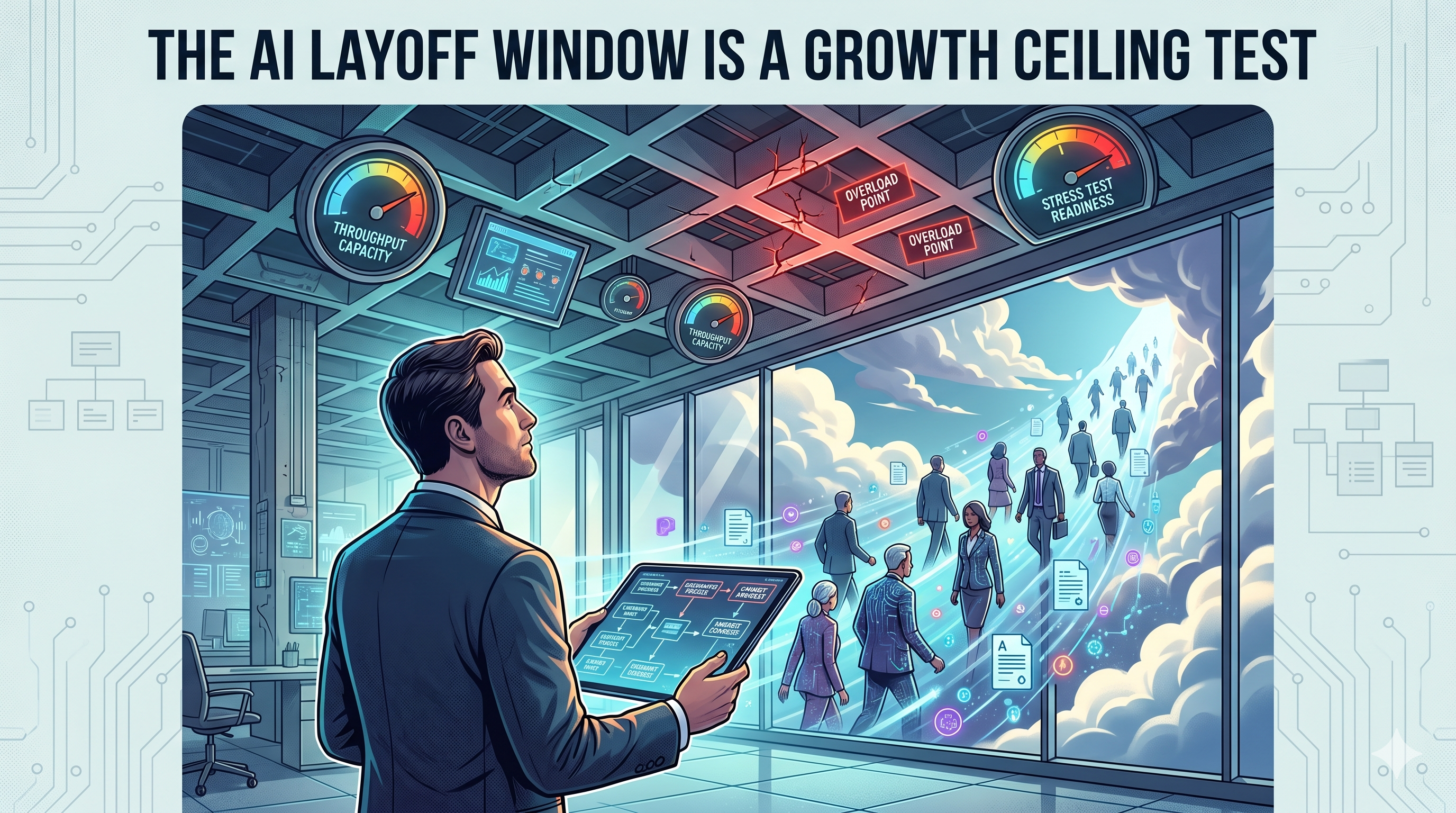
The AI Layoff Window Is a Growth Ceiling Test
The layoffs keep coming. Whole departments are getting restructured around AI. Senior operators with fifteen years of industry knowledge are suddenly available. Competitors are distracted enough that their accounts are starting to shake loose. If you run a service business, you have probably felt the pull: move now, grab the talent, pick up the clients your distracted competitors are about to drop.
So founders are asking two questions. Is this the right time to move? And can I land that senior hire before someone else does?
Both questions miss the point. Whether you capture anything from this market has almost nothing to do with timing and little to do with talent. It comes down to one thing: whether your business can take on more without breaking. More clients, more people, more revenue moving through a delivery process you have never pushed past its current limit.
That capacity is not something you decide in the moment. You either built it before the window opened or you did not. And the founders who move without it do not break through their growth ceiling. They build a higher one: more clients they cannot onboard cleanly, more hires they cannot integrate, more revenue that strains delivery and erodes margin.
This is a systems readiness decision dressed up as a timing decision.
The opportunity is real. Your capacity to use it is the variable.
Senior talent at this level rarely comes onto the market in volume, and accounts that took competitors years to win are in play.
The mistake is treating the moment as a demand problem when it is a throughput problem. Acquiring those inputs assumes a machine is running underneath that can convert and deliver them at higher volume.
The talent, the leads, the loose accounts: they all have to flow through something. Most service businesses between $1M and $10M have never tested that assumption, because nothing has ever forced them to. The business runs smoothly at its current volume, so the founder assumes it can absorb more. Smooth at current volume proves nothing about the next level.
Every service business has a throughput ceiling: the volume past which quality, margin, or the founder’s sanity starts to degrade. Most founders have never measured theirs because they have never been pushed past it.
Handoffs break before the work does
When volume rises in a founder-dependent business, the work itself usually holds. The handoffs fail first.
The new client gets onboarded differently than the last one because there is no documented standard. The new hire spends six weeks guessing because nothing is written down, and the official training plan is “ride along with this guy and he’ll show you.” The founder reads this as people being slow. They are not slow. They have nothing to follow.
What hides this problem at steady state is the founder personally absorbing the friction. The founder is the load-bearing patch: filling every gap, remembering every exception, routing every nonstandard decision through their own head. It is the reason the business has stayed at its current level. As volume rises, the founder cannot be in every gap at once, and all the gaps become visible at the same time. The window does not create the weakness. It exposes the weakness that was already there.
Measure throughput in days, then stress test it
The fix starts on paper, not with a tool purchase. Document the convert and deliver path: signed to onboarded, onboarded to delivering, hired to productive.
For every step, answer the RACI questions: who is responsible, who is accountable, who gets consulted, who gets informed.
Then make throughput measurable. How many days from signed contract to first delivered value? How many days from hired to fully productive without supervision? If you cannot answer in days, you cannot plan to scale, because the bottleneck is hiding inside the guess.
Now stress test it. Picture three new clients signing in the same week instead of one. Walk each step and ask who does what, and when. If at any point your answer is “I would handle that,” you just found your constraint. That step is exactly where the business breaks when you move on this market.
This is also where AI belongs in the conversation. AI compresses lead capture, content production, and pieces of delivery, but it does not understand handoffs, because handoffs require a human who knows what happens next. If you cannot describe the process, you cannot automate it. Inject AI into an undocumented business and it feeds volume into the gaps that were already failing, faster than the founder can patch them.
What not to do with this window
Capacity is not permission.
Do not lower your standards to move faster. The point is scaling your standards, making them capable of absorbing more, not abandoning them. Do not chase every displaced client. A window does not make a bad fit client a good fit client, and abandoning your positioning to grab volume erodes the moat you spent years building. And do not overhire ahead of documented capacity. Adding people to an undocumented system makes the system harder to fix.
The payoff for doing this right compounds well past this window. A tested convert and deliver path does more than catch this window. It makes revenue predictable. It reduces the business’s dependence on the founder. It raises the long-term value of the company for any future buyer.
This is what it looks like when the Viability layer of a business is actually working: volume can rise without the founder in the middle, and growth stops being a white-knuckle event. Building the readiness usually breaks the plateau the founder was stuck at before the opportunity ever showed up.
Find your throughput ceiling before the market does
The market is handing some founders a real opportunity and handing others a faster way to overload a business that was already strained. The difference is not who moves first. It is who built the capacity to hold what they catch.
If you want to know where your throughput ceiling actually is, take the Growth Ceiling Assessment. It takes five minutes and shows you which part of your growth engine needs attention before you add volume to it.
You can also hear the full conversation, including the 60-second stress test and the one-week handoff experiment, on this episode of The Growth Ceiling. (Link above).
And if you would rather walk your specific situation through with us, book a free Growth Clarity Call. 45 minutes, no pitch, and you leave with a clearer view of what your business can absorb.