Business Systemization: Which System Breaks Your Growth Ceiling First
Related Episode
Your Growth Ceiling Is Not a Systems Problem. It Is TriageYou documented everything. The business still stalls without you.
You wrote the standard operating procedures, mapped the workflows, and bought the project management platform. It is more documented than it has ever been, and none of that changed what happens when you step away.
So you reach for the obvious fix: more systems. More process across delivery, sales, hiring, finance, and decision-making, all at once. Six months and real money later, the ceiling has not moved, and you are starting to believe systems just do not work for a business like yours.
They do. You are building the wrong ones. Most founders treat business systemization as a completeness project, a race to get the whole business on paper. It is not. It is triage. Your growth ceiling is set by one binding constraint, and the only system worth building first is the one that relieves it.
A business is a system, and systems break at one point
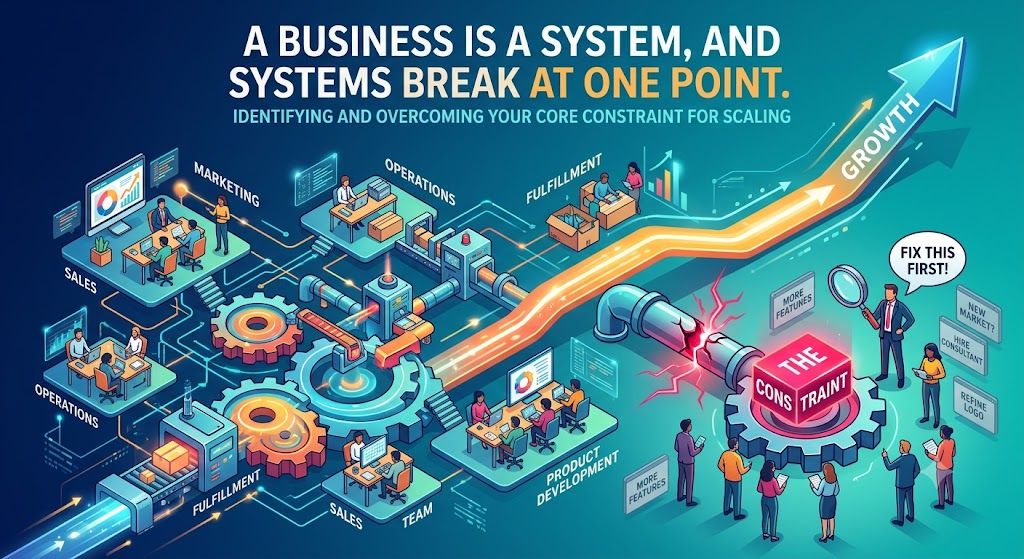
The simplest accurate definition of a business is a system: a set of connected functions that depend on each other. In any system, when one part is out of tolerance, every connected part feels it. A car with one flat tire is not a car with one minor issue. It is a car that will not move, and every other working part is now beside the point.
A stalled business behaves the same way. One function is binding, and it pushes stress downstream into everything it touches. The founder looks up and sees five problems. Four of them are smoke from one fire. Documenting the four smoking functions changes nothing, because they were never the cause. This is why a complete library of process documents built on top of a flawed system gives you well-organized dysfunction.
Action step: list the parts of your business that feel broken, then ask which one, if it were fixed, would calm the other four. That is your candidate constraint.
Why the real constraint hides from the founder
The binding constraint tends to be the messiest, least defined part of the business, the part everyone steps around rather than steps into. Often it is tied to the founder personally: the decision only they make, the approval only they give, the knowledge that lives only in their head. That is founder dependency, and it is the reason the business falls apart the moment the founder steps away. When you are the glue holding everything together, you rarely notice you are also the bottleneck.
An owner is sure they need someone running their social media, so they hire a full-time person to do it. The new hire posts nothing, and the owner assumes the hire is the problem. The real gap is that the owner holds all the strategy and never handed over a framework or a topic list. The constraint was never social media. It was decision dependency. Hiring around it only moved the waiting in-house.
Action step: ask your team what they rebuilt or redid in the last month. If they polished a function that already worked, you are relieving the wrong thing.
How to find the one system to build first
The binding constraint is wherever work backs up and waits. Find the queue. If proposals sit waiting on your review, your constraint is decision-making, not lead generation. The pile is not always physical. It can look like twenty browser tabs of unfinished work or twenty unread emails from your team asking you to make a call.
Most constraints fall into one of four places: founder dependency in decision-making, the sales pipeline and conversion, client delivery and retention, or hiring and capacity. Name which one is binding, then commit the next 30 days to it alone. As James Clear put it, we do not rise to the level of our goals, we fall to the level of our systems. The work is choosing which system.
Action step: pick the single constraint with the longest queue and define what “relieved” looks like before you build anything.
Build by hand first, then automate
Built does not mean automated. Built means the function runs to a written standard the team can follow without the founder in the loop. Automation comes after, never before, because you cannot automate a process you have not made consistent. Automate a broken handoff and you get a faster broken handoff. Define the business system by hand, prove it holds, then automate the parts that repeat. And measure the right thing: whether the pile is shrinking, not how many documents you wrote. Throughput is the scoreboard. Documentation is just the tool.
Action step: set one measure that shows the constraint is easing, check it weekly, and re-diagnose once it holds for a month without you.
Where this fits in the V3 Growth System
This is what it looks like when Viability is working. Visibility brings in the leads, but Viability is the layer where the business converts effort into output without the founder carrying every handoff. When you relieve the true binding constraint, functions you never touched start working better on their own. The downstream stress they were absorbing disappears. Fix the sales handoff and delivery often calms down with no new delivery system. The three layers are not separate projects. They are one engine, and you free it by relieving the binding link.
Start with the constraint, not the checklist
Systemization does not fail because you built too few systems. It fails because you built them everywhere at once instead of at the one place holding you back. Find the binding constraint, build the one system that relieves it, then re-diagnose and move to the next.
If you want this thinking every week, subscribe to the Growth Ceiling newsletter at thegrowthceilingpodcast.ghdunlimited.com. Each edition takes one real growth constraint and shows you how to spot it in your own business. For the full diagnostic, listen to the episode linked below. And if you would rather map your specific situation directly, click here to book a free Growth Clarity Call.