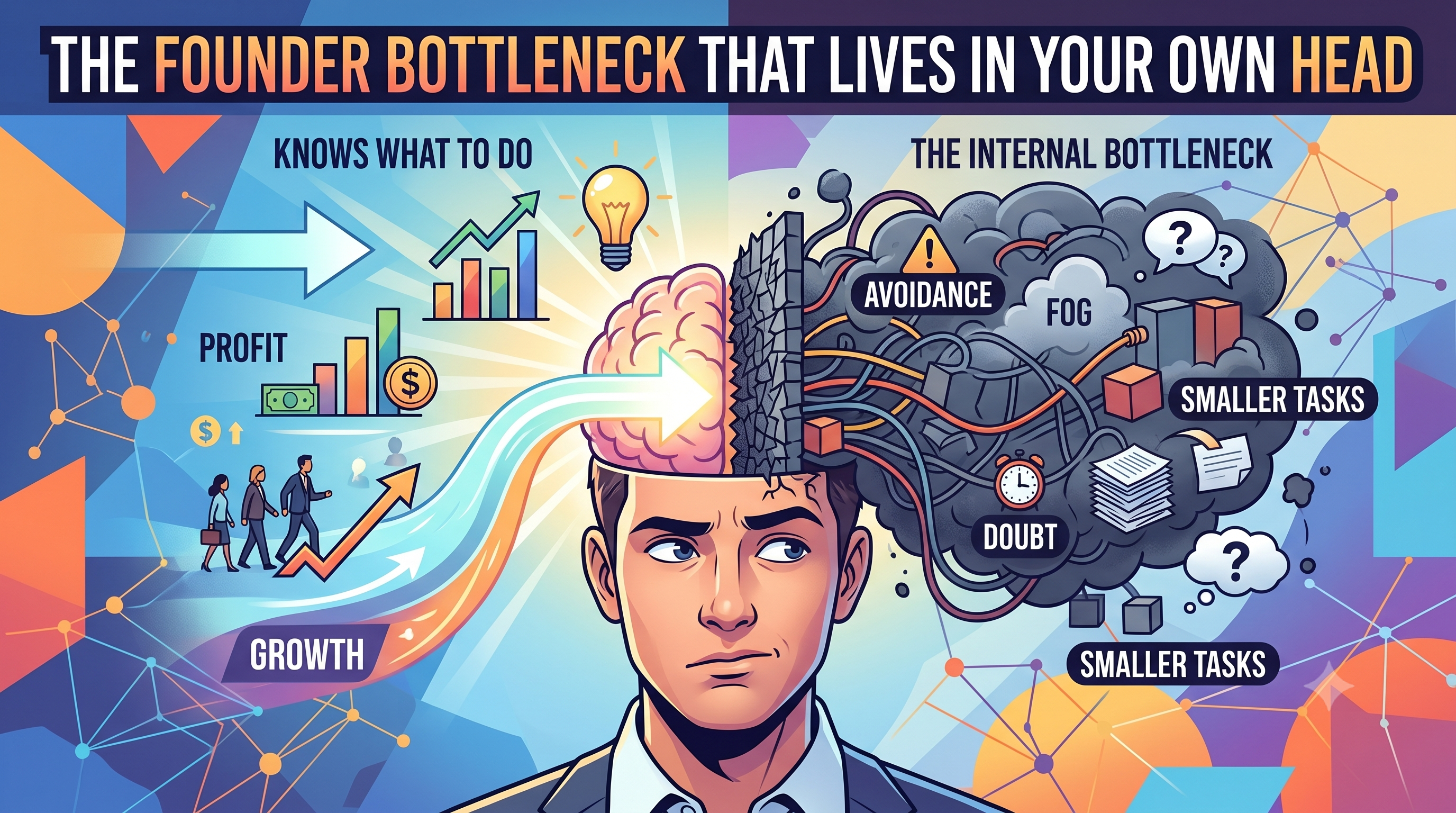
The Founder Bottleneck That Lives in Your Own Head
“Push motivation always has a ceiling. Once you get far enough from what you feared, the thing that drove you becomes the thing that holds you back.”–Aaron Morrison, WyldFyre Dynamics
You know what to do. You have known for weeks. The plan is sound and the next step is obvious, and you still find a reason to handle something smaller first. Then you tell yourself you have been busy.
Most founders read that as a discipline problem and go looking for a better system or a harder push. Both miss the actual constraint. For a founder running a service-based business, the limit on growth is often not the strategy at all. It is an internal barrier that fires at the exact moment action is required. This is the founder bottleneck almost nobody diagnoses, because it does not look like a bottleneck. It looks like being busy.
The symptom every founder misreads
There is a difference between a performance problem and an internal barrier. A performance problem is one you can see and name. An internal barrier is the program running underneath: the avoidance, the sudden fog, the decision you are fully capable of making and somehow keep circling.
Aaron Morrison, a performance coach and sales strategist who spent twenty years in sales before founding WyldFyre Dynamics, uses a simple test. Look at the gap between the results you want and the results you have. The size of that gap tells you how much of your behavior is being driven by something you did not consciously choose. When you know precisely what to do and still avoid it, the problem is not information and it is not strategy.
Why “push through it” breaks on an internal wall
The standard advice for a stuck high performer is to push harder and get more disciplined. Sometimes that is exactly right. When nothing internal is in the way, a founder just needs to do the thing.
But when an unconscious program is running, willpower breaks on it. Morrison’s explanation is worth understanding even if you never work with him. Every behavior carries a positive intention for the person doing it, usually self-protection. The unconscious mind keeps a behavior because it believes that behavior is the most efficient option available. You do not remove it by force. You remove it by presenting a better option, then letting the system make the switch. The skills that built the business are not the problem. The hidden assumption underneath them is.
The revenue roller coaster
In a small business there is no buffer between the founder’s internal state and the company’s output. When the founder hesitates, the company hesitates. Morrison calls the pattern this produces the revenue roller coaster. The bank account drops, urgency rises, the founder takes action out of necessity, revenue recovers, comfort returns, and the action stops. Then the cycle repeats.
The same dynamic shows up in motivation. Many driven founders are powered by away-from motivation. They built the business to escape something, and that push works until they get far enough away, at which point the thing that drove them becomes the tether holding them in place. Morrison described a client earning $2.5M a year who had stalled for exactly this reason. The work was reorienting him toward what he wanted instead of away from what he feared.
The cost of leaving this in place is not only revenue. Asked what it actually costs, Morrison did not hesitate: everything. Peace of mind, profitability, confidence, and the knowledge at the end of the day that you did your best work. A founder can get away with not trying as hard and still get a result. What they cannot do is hide their own underperformance from themselves.
What clears it, and where the systems work begins
When the internal resistance clears, the change tends to show up fast. Morrison’s clients report getting fifteen to twenty-five percent of their time back, not from a new tool but from no longer fighting themselves. One client came to him to make more money and doubled his income from $120K to $240K in a year, and repaired his marriage along the way. The results compound because the founder’s state sets the standard for the whole team. People do as the founder does, not as the founder says.
There is a clean boundary here, and it matters. Clearing the internal barrier is where Morrison’s work ends. Codifying the new standard across the team, through documented processes and the right operating roles, is a different layer of the business. That is the systems work, and it is exactly where a clear-headed founder can finally make it stick.
This is what it looks like when the viability layer of a business is working. Viability is whether the business, with the founder inside it, can execute consistently and predictably. You can have the right strategy and the right market and still stall at the point of action because of something you cannot see. Clearing that barrier is often the difference between knowing your next move and making it.
If you are not sure whether your own growth is stalling on strategy or on execution, that is the question worth answering before you change anything else.
Get the weekly constraint read. Each week, one real growth constraint and how to spot it in your own business. Subscribe at thegrowthceiling.com.
Listen to the full conversation with Aaron Morrison at the link above.
Click here to connect with Aaron
Want it diagnosed in your business? Click here to book a free Growth Clarity Call and leave with your constraints ranked by revenue impact.