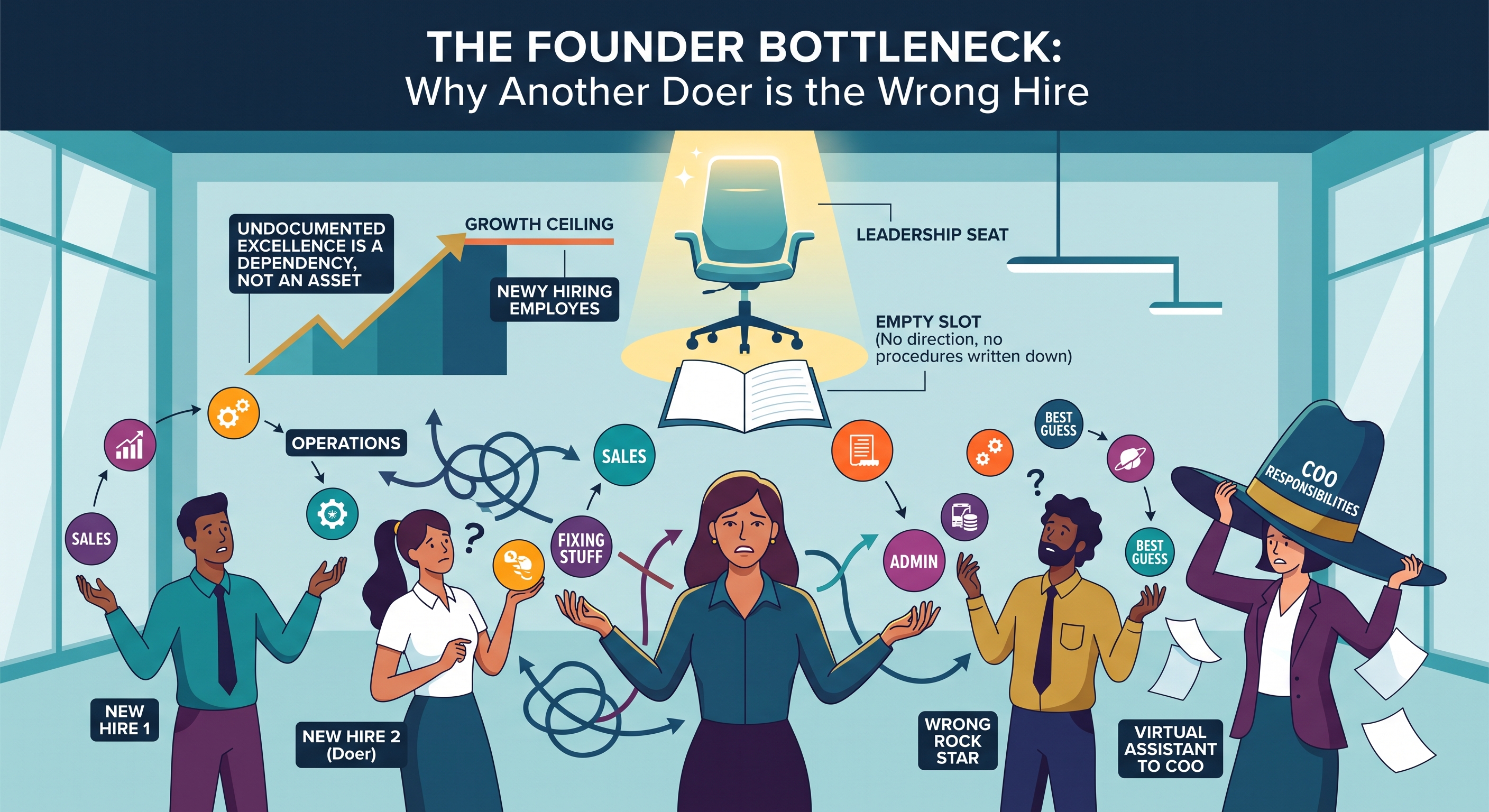
Founder Bottleneck: The Leadership Seat You Keep Filling Wrong
You can have a very expensive payroll and go in the really wrong direction very quickly. You can bring in the wrong rock star. Kati Peterman, FRX
You know the feeling before you can name it. You are running sales, running operations, approving everything, and fixing whatever broke this morning. The obvious answer is more hands, so you hire. For about a quarter it feels lighter. Then the weight comes back, and now it comes with a bigger payroll.
Most owners read that as a hiring mistake. It usually is not. It is a diagnosis mistake.
The founder bottleneck looks like a workload problem because workload is what you feel. But the seat that is genuinely empty in most growth-stage service businesses is not a doing seat. It is a leadership seat, and it stays empty even after you hire, because nobody has written down enough for another person to step into it.
Why another doer is almost always the wrong hire
Kati Peterman places fractional executives with owners across marketing and sales, finance, leadership, operations, and personnel. She works with home services, medical spas, and dental practices between five and fifteen million in revenue, and she has interviewed more than a thousand business owners about what they think they need.
Her observation is that owners hire fast and hire wide. You can build a large payroll very quickly. What you cannot do quickly is create direction. If nobody is casting the vision, communicating the mission, or telling people where the company will be in five years, then every person you add is executing against their own best guess.
That is how a company ends up moving fast in a direction the owner never chose. As Peterman puts it, you can bring in the wrong rock star. Someone who was genuinely excellent somewhere else, hired into a business that has not decided what it is, will not become excellent here.
There is a second version of the same mistake at the executive level. Owners promote a virtual assistant or an executive assistant into a role they treat like a chief operating officer, expecting them to execute on the owner’s behalf without the authority, the information, or the definition of the job. And plenty of companies hire a chief financial officer when what they actually needed was a bookkeeper or a data analyst.
Action step: before you write a job description, write down what would still be true about the business if you were unavailable for a month. Whatever breaks first is the seat.
The cost that never appears on your profit and loss
There is a number missing from every founder’s financial review, and it is the one that predicts whether they will still want this business in three years.
Peterman describes it as the loss of joy. The owner started because something about the work energized them, usually the relationships and the conversations. Then the admin, the billing, the payables, the invoices, and the payroll accumulate. Three and a half days of work that a bookkeeper would clear in two hours.
That does not show up in the financials. It shows up in the quality of your relationships, in whether you are pleasant to be around on a weekend, and eventually in whether you still believe in what you built. And because the person selling the vision is you, a founder who has stopped feeling it becomes a business that stops converting.
When she was asked to finish the sentence “you need leadership, not another doer, when,” her answer was one line: when you are not experiencing joy.
Action step: list the three tasks that consistently ruin your week. Price out what it would cost to have someone else do them, then compare that number to what your time is nominally worth.
Name your phase, and make everyone agree on it
Peterman works from five phases of business: startup, perseverance, viability, scaling, and exit or succession. Every company passes through all five, though not every owner wants to reach the later ones, and staying deliberately in viability is a legitimate choice.
Her definition of startup is the useful part. Startup is a predetermined amount of time and a predetermined amount of money. You commit to a window and a budget, you do specific things inside it to reach profitability, and if you reach the end of both without hitting the mark, you stop. Most owners do not stop. They keep spending past the point where a clean pivot was still available.
The more common failure is one that is often not discussed. Everybody in the company believes a different phase is true. The owner thinks the business is viable. Part of the leadership team thinks it is in perseverance. The staff, watching turnover and constant hiring, experiences a startup. So when leadership makes a call, it looks arbitrary to everyone whose mental model differs, and buy-in evaporates.
Companies also regress, and usually the owner causes it. The founder returns from a conference with new ideas, changes direction before the last change produced any data, and knocks the company from viability back into perseverance. Peterman’s rule is no major changes inside a ninety-day cycle, and no significant financial changes inside forty-five days. Hold long enough to get real data, then decide from the data.
Action step: write down your phase and your intended exit date from it. Then ask three people on your team what phase they think you are in, separately, and see how far apart the answers are.
The four things to build before you hire an executive
Peterman’s position is that every company needs the same four deliverables, regardless of industry or size.
A documented SIPOC. Supplier, input, process, output, customer. Where your leads come from, what happens the moment one arrives, what your operation does with it, what you actually deliver, and what the customer experiences end to end. Reviewed quarterly.
A meeting and communication structure. Without one, a company runs on taps on the shoulder and “hey, you got a minute.” Productivity drains and nobody can point to where it went.
Core KPIs. Not fourteen reports every Tuesday that nobody can justify. The two or three numbers per function that decisions actually get made from.
Roles and responsibilities on a real org chart. Everyone knows what they own, who they report to, and where to go for support. Peterman’s read on the phrase “we wear a lot of hats” is that it means nobody knows what they are doing, and the payroll is going out the window.
There is a commercial reason to do this beyond your own sanity. If you ever sell, a buyer looking at a company where all the revenue comes from one or two people, with no documented process explaining why, sees risk rather than performance. Undocumented excellence is not an asset. It is a dependency.
Action step: open a blank document and map your SIPOC end to end. Stop at the first question you cannot answer. That gap is your first project.
What this looks like when Viability is working
This whole conversation sits in the Viability layer of the V3 Growth System, the question of whether the business can generate and run its revenue without the owner in the middle of everything. Viability is not a feeling about the business. It is a set of observable conditions: the right people in the right seats, a documented operating system, and decisions made from data rather than instinct. When those exist, leadership has something to lead. When they do not, hiring is just an expensive way to relocate the chaos.
Where to start
You do not need all of this in place before you do anything. You need enough of it that another person could pick up one thing and run with it.
Start with the phase. Write it down, get your team to say it back to you, and commit to a date. Then pick the pillar you have looked at least in the last thirty days and open it up properly.
Get the weekly constraint read. Each week we take one real growth constraint and show you how to spot it in your own business. Subscribe in the footer below.
Listen to the full conversation with Kati Peterman linked above.
Not sure whether your constraint is leadership or something further upstream? Book a free Growth Clarity Call . Forty-five minutes, and you leave with your three constraints ranked by revenue impact.