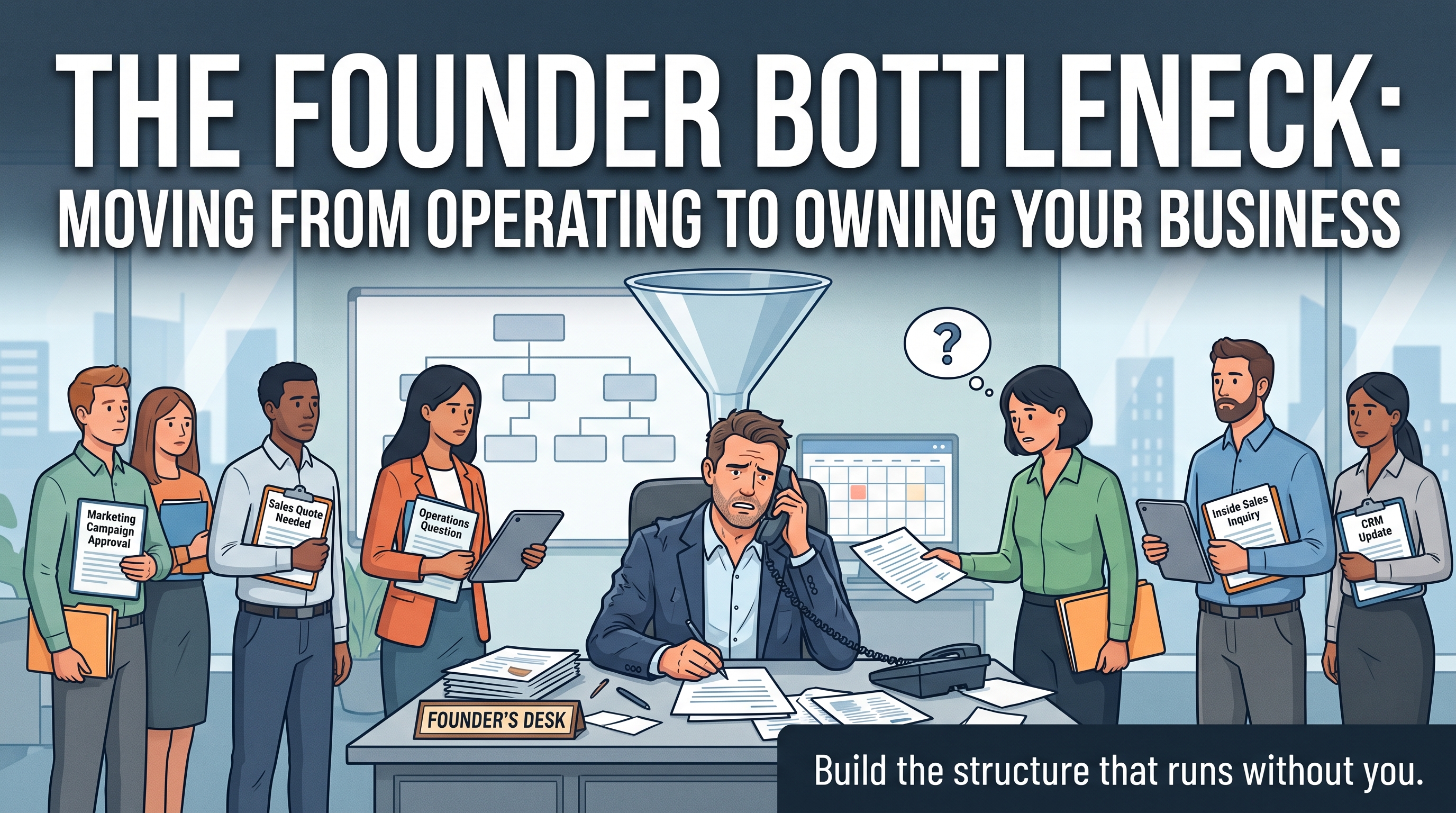
The Founder Bottleneck Is Not a Time Problem
Your job as an owner is not to stop putting out fires. It is to reduce the amount of fires that you are the one putting out, because you have a team who can put them out for you. –Chris Atwell, founder of Mindset-Conquest
You have a team now. Operations, marketing, inside sales, someone running quotes. On paper the business does not need you for most of what happens in a week.
In practice, it stops when you are gone.
Every owner who reaches this point runs the same experiment. They clear the calendar. They delegate a batch of tasks. They promise themselves they will stop doing the work they hired people to do. Six weeks later they are back in the middle of everything, and the explanation they reach for is time. There is not enough of it. The team is not stepping up. Maybe the team needs training.
That explanation is comfortable and it is wrong. The founder bottleneck is not a workload problem. It is a structural one. Every decision in the business still terminates at the owner’s desk, and no amount of calendar management changes that, because the calendar was never the thing holding it in place.
Why the best salesperson becomes the worst bottleneck
Look at how most owners got the job.
In manufacturers’ rep agencies, the businesses Chris Atwell spends his days inside, it is usually family succession. A grandfather started it in a garage, a father grew it, and a third generation now runs a company doing tens or hundreds of millions in top-line sales. In most service businesses the path is shorter. You were the best salesperson, so the business became yours.
Either way you arrived on the strength of one skill. Selling. Atwell, who led sales teams across manufacturing and distribution for over a decade before founding Mindset-Conquest, draws the distinction sharply: solving a customer’s problem is one skill, and teaching a team to solve it is a completely different one. Nobody trains for the second.
So when a team member handles something differently than you would, you step in. You fix it, or you take the call, or you finish the quote. It feels like leadership and it is the opposite, because you have just taught that person to bring you the next one.
Do this: For one week, write down every problem that comes to you. Next to each, note whether the person could have solved it with information they already had. That column is your bottleneck, measured.
The four reasons a team is not performing, and the two that are yours
Atwell uses a breakdown that ends the “my team will not hold themselves accountable” conversation quickly.
There are four reasons a person is not performing. The expectation was never clear. They do not know how to meet it. They have decided not to. Or they are in the wrong role.
The first two belong to the owner. If your people cannot repeat an expectation back to you in a sentence, it was never set, and that is a leadership gap, not a performance one. If they can repeat it but cannot execute it, you never gave them the training or the tools. Only the last two are about the person.
This matters because of what owners typically ask for. Atwell says they come to him wanting sales training for the team. When he asks what their own approach is to holding people accountable, or how well they understand the CRM they expect the team to maintain, the answer is usually silence.
Do this: Take your most frustrating performance issue. Work the four reasons in order and stop at the first one that is true. If you stop at one or two, the fix is yours.
The four jobs that belong to the owner and nobody else
There is a transition every growing business demands, from operating the business to owning it. Operating means doing the work. Owning means building something that runs without your hands in it.
Atwell names four jobs that cannot be handed off. Your people, meaning development, the right roles, the tools to grow. Your systems, meaning the processes that create efficiency and capture usable data. Your numbers, meaning forecast, pipeline, commissions, expenses, known well enough that you are not running the week on instinct. And your strategy, meaning a plan the whole team can move toward.
The objection is always time. The answer is the calendar, treated as fixed. Block the four, protect the blocks, and create separate space for when people need you, rather than letting other people’s meetings define the week by default.
Underneath those four sits one unglamorous system: a standing one-on-one with each person, every week or every other week, where you review last week’s priorities, agree on this week’s, and talk about what they are developing. The person whose meeting it is runs it, not you. And it does not move for a customer call. Atwell notes those meetings are the first thing owners cancel, which is the whole problem in miniature: the urgent thing beats the important one every week until team development has stopped happening at all.
Do this: Put the four blocks in next week’s calendar before anything else goes in.
Building the second layer before you need it
Every owner arrives at the same crossroads. I cannot handle it all, and I am the only one who knows how.
The exit is not a hire. It is looking at the people already working for you and asking who could lead later. Who is coachable. Who takes ownership without being asked. You will not see that while you are buried in daily work, which is why it belongs inside the strategy block rather than alongside it.
Then start small. Atwell gives one person ownership of one named outcome. In his example, a CRM implementation: not a title, not a department, one outcome with the responsibilities written out. Then another. You are developing a leader well before you give anyone the word manager.
Most companies miss a related point. They have a solid onboarding plan for a new hire and nothing at all for a newly promoted manager. The best salesperson gets the team, gets no preparation, keeps selling because that is what feels safe, and gets written off as a bad manager within a year.
Do this: Name one person who could lead in two years. Give them ownership of one outcome this month, in writing.
What it looks like when Viability is working
This is a Viability conversation from start to finish. Visibility brings you leads. Viability is whether the business can carry them without the owner in the middle of every handoff. When the Viability layer is working, decisions get made at the level where the information already lives, and the owner’s time moves from settling disputes to building the next five years.
Atwell describes the shift he sees in owners who get there. They stop putting out fires and start reducing how many fires reach them at all. They stop selling to every customer and manage the top relationships at a senior level. They stop approving every quote and build the system that approves them.
Where to start
The bottleneck is not your workload. It is where decisions live. Move that, and the business stops running on your stamina and starts running on its own structure. That is the difference between a job you own and a business that holds value.
If you want to see where this sits in your own business, we are running original research right now. The Growth Ceiling Report walks you through the eight stages of a revenue system and asks which ones run without you, which leak, and which do not exist. Sixteen questions, about four minutes, and you see your own count the moment you finish.
Take the survey on this website by clicking here.
Listen to the full conversation with Chris Atwell linked above.
And click here to get in touch with Chris on LinkedIn.