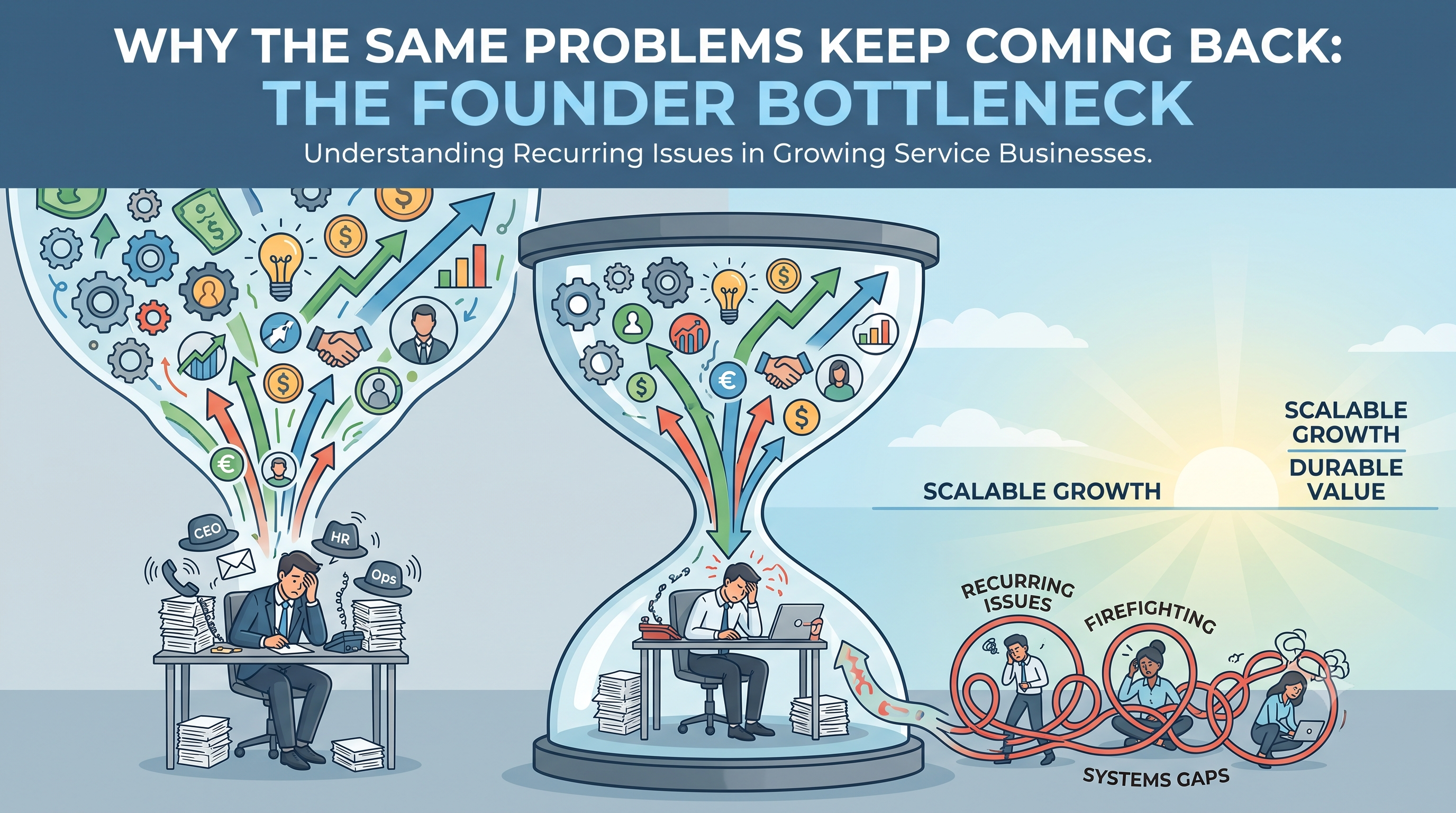
Why the Same Problems Keep Coming Back: The Founder Bottleneck
Structural problems almost never arrive looking like structural problems. They arrive looking like a people problem, a marketing problem, a timing problem. –Peter S Bergeron, The Growth Ceiling Podcast
Every owner of a growing service business knows the feeling. You fixed the thing that broke last quarter. Now something else is breaking, and it feels familiar, like you have stood in this exact spot before. The usual response is self-directed: sharpen up, hire better, put in more hours.
Peter S Bergeron spent fifty years testing that response from the inside. He started on his father’s showroom floor at four years old, worked two decades across bookkeeping, controller, and operations roles, then ran the family business until it closed in January 2020. The closing sent him back for a doctorate at Johnson & Wales University focused on family business succession, and the research produced The Trapped Operator and the 12 Fatal Issues Framework.
What he found reverses the usual story. The recurring problems were never discrete events, and they were never a verdict on the owner’s discipline. They are structural pressures that build up in businesses that look perfectly healthy, and they are common enough to be predictable. The founder bottleneck is not a character flaw. It is a design outcome, which means it can be redesigned.
A healthy business can still be fragile
Revenue up, customers happy, team in place. And underneath: an owner wearing three hats that appear nowhere in the pricing model, systems built for the twenty customers the business has instead of the forty it is heading toward, and a growth plan with no cost line for replacing the owner’s unpaid labor.
Bergeron’s point is that almost nobody starts a business trained in what he calls the business of running a small business. Owners are trained in the work itself, so the background machinery, financial controls, terms, documentation, decision rights, gets assembled by happenstance. The business is healthy at its current size and already wrong for its next one.
Action step: run one service line through its true delivery cost, including your own hours at a market rate. If the margin only works because your labor is free, the model has a structural gap, not a sales problem.
An event needs a fix, a pattern needs a redesign
Bergeron separates the two with a cash example. One reliable client suddenly stretches payment from forty-five days to seventy-five: an event. All of your clients routinely pay at seventy-five days because no process defines your terms: a pattern. Both get labeled a cash management problem. Only one of them is telling you something about your structure.
His twelve issues earn the word fatal because any one of them, left running, can take a business down over time. He organizes them the way owners actually experience them: foundational issues like financial control and regulatory compliance, developmental issues like customer service and market presence, and transitional issues like strategy, leadership, and human resources. Structural problems almost never arrive labeled correctly. They arrive looking like a people problem, a marketing problem, or a timing problem.
Action step: sort last quarter’s fires into events and patterns. Anything that has happened at least twice goes on the pattern list, and each pattern gets traced to the system that produced it rather than the person nearest to it.
The owner is the variable every model leaves out
The framework’s distinctive move is putting the owner at the center of the model. Two businesses with identical revenue and headcount can carry completely different risks, because each was built around a different person’s beliefs, fears, and comfort with risk. A two to three million dollar company with a team of twelve could be a regional HVAC operation or a national financial services firm. Revenue and headcount predict very little. Why the owner built what they built predicts a lot.
That is why Bergeron’s first diagnostic is behavioral, not financial. Keep a notepad and tick every task that lands at your feet that should belong somewhere else. Notice the point where your only answer to recurring pressure is working harder while nothing moves faster. And ask the uncomfortable question he considers the best starting point: what are you afraid of? The pressure you avoid examining is usually the one accumulating.
Action step: for one week, keep the notepad running. At the end of the week, label each tick with the role that should own that task. That list is a map of the founder bottleneck in your business.
Durability is what a buyer pays for
Bergeron’s research centers on succession, and the numbers are blunt. A business with documented processes, distributed decision authority, and contained structural pressures can be worth five, six, seven times a business with none of those things. One sells as a company. The other fire-sells a product line, which is how his own family’s story ended.
His definition of the goal: a business is durable when it can function, grow, and transfer value independent of its founder. The test is a single question. Who is driving the growth? If the team drives it, the growth is durable. If every win runs through the owner, the growth is a workload with the owner as its ceiling.
The payoff shows up well before any exit. When decision authority is distributed and documented, the team stops bringing questions and starts bringing ideas, and the owner gets to run the business with intention instead of triage.
Action step: name who drove your last three growth wins. If the honest answer is you, all three times, pick one upcoming decision and hand it, in writing, to the person who should own it.
This is what it looks like when the Viable layer of a business is working: structure carries the load, the owner steers, and the value being created belongs to the company instead of living in one person’s head. It is also the bridge to the Value layer, because the structure that gets you out of the weeds is the same structure a successor can inherit.
Keep going:
Get one real growth constraint each week, and how to spot it in your own business: subscribe to the newsletter at thegrowthceiling.com.
Hear the full conversation with Peter S Bergeron at the link above. His book, The Trapped Operator: How to Build a Small Business That Outlasts You, is at thetrappedoperator.com.
If the recurring problem in your business already has a name and you want to know which layer produces it, book a free Growth Clarity Call: meeting.calendarhero.com/gsc. 45 minutes, and you leave with your three constraints ranked by revenue impact.