Founder Bottleneck: Why Every Owner Needs Two Exits
Related Episode
Founder Bottleneck: Plan Two Exits From Day One (Della Kirkman)Ask a business owner what the company is worth, and many will give you a number that came from somewhere other than the books. They add up the retirement they want: the yacht, the golf membership, the trip they have promised their spouse for twenty years. The total feels fair, so the business must be worth at least that.
Della Kirkman, a CPA who advises on both sides of small business deals, calls this the pie in the sky valuation method. She has watched what happens when it meets a buyer. The buyer asks who closes the sales, and the answer is the owner. The buyer asks for the payroll behind an add-back, and it runs through a different company. The buyer asks who owns the equipment, and three months later nobody has answered.
Each of those answers costs the seller money, and most of them trace back to one thing. The business still runs through the founder.
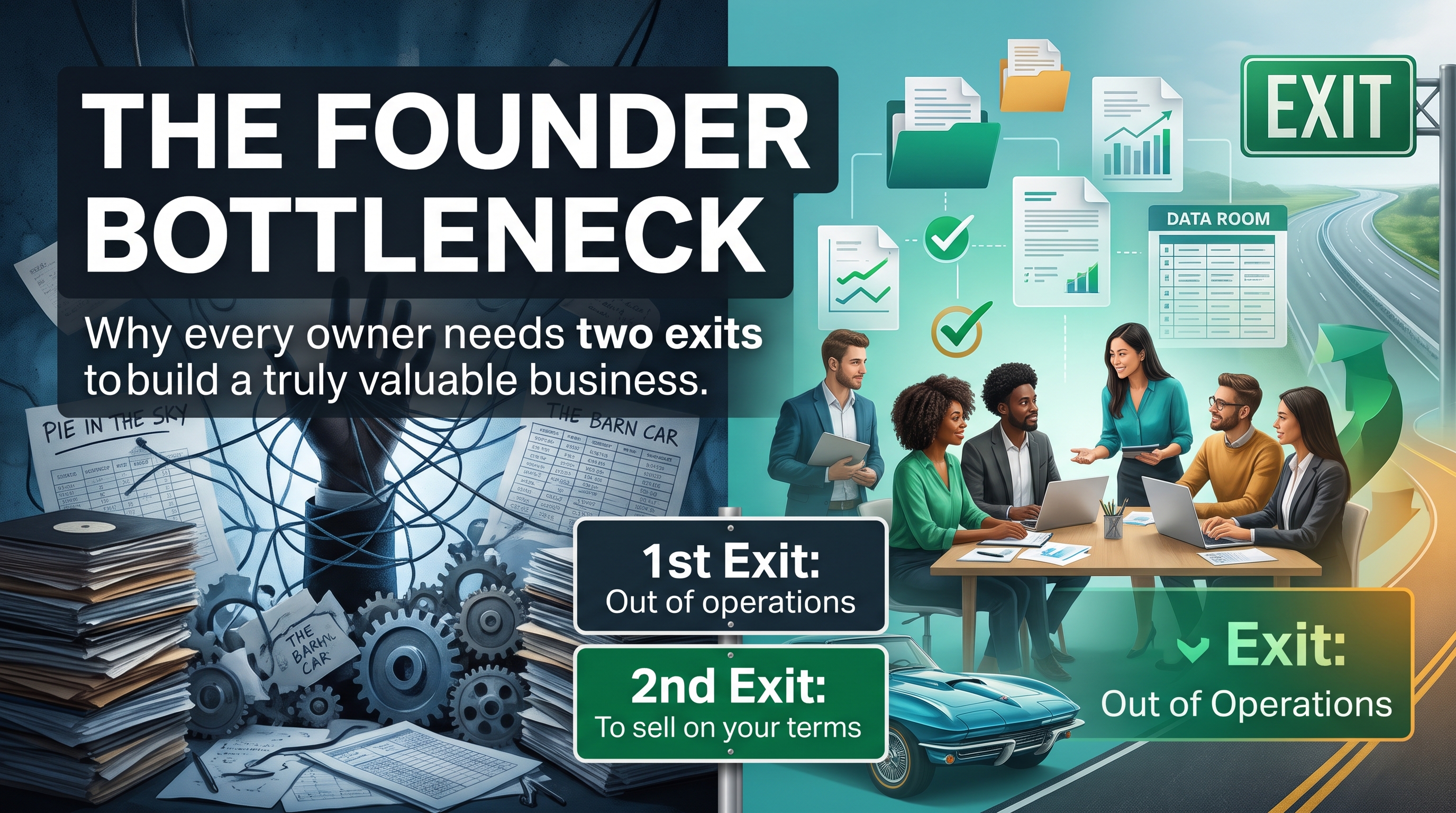
Della’s advice is to plan two exits from the first day you own the business. The first exit takes you out of the day-to-day operations. The second takes you out of the business, on your terms. The work that gets you through the first exit is the same work a buyer pays for at the second.
Why the founder bottleneck lowers your sale price
Della’s rule is simple: the less the business depends on you, the more valuable it is.
The trouble is that founder dependency rarely shows up on paper. It is not on the tax return or in the bookkeeping. A buyer finds it by asking questions, visiting the business and listening. There are clues. No manager. No sales team. A small marketing budget, which usually means the clients arrive through the owner’s own relationships.
Sometimes the owner states it outright. One seller Della is working with told her that only a handful of people in the country can do the tool and die work he does on his machines. He meant it as a point of pride, and he has earned it. At the negotiation table it reads as risk. If the business needs one person who cannot be replaced, the buyer is buying a job, and buyers do not pay much for a hard job.
Della puts it with two jobs that both pay $100,000. One is at a laptop in a coffee shop. The other is digging ditches through a northern Indiana winter. Everyone takes the laptop. A buyer looks at your business the same way: how easy will it be for someone else to make money from it?
Action step: Write down the three things in your business that would stop if you were gone for a month.
Plan two exits from day one
The first exit pays you long before any sale. A business that does not need you every day is more profitable, and in Della’s experience it is more fun to run. She asks owners to look in the mirror. Most will admit they are the biggest bottleneck in their own business.
Her advice on where to start is practical. Hand off the work you dislike or are not good at first. In her own tax practice, payroll and bookkeeping went to the team early. Every client had a written procedure, so anyone who knew QuickBooks could open a client file and follow the steps. She kept the tax returns, the work she loved, until later.
The second exit starts three to five years before a sale. Della’s first step is a realistic business valuation, built from the numbers. Then comes a personal conversation many owners skip. Can you live on what the business is actually worth? What will you do after the sale? A season of golf wears thin. A pivot may mean a non-compete and startup costs. If the number falls short, three to five years is enough time to change it.
Waiting has its own cost. Della recently heard about a broker who sold his own business at 83 with no exit plan, and about a 73-year-old owner who wants to sell but will not spend $5,000 to get her books cleaned up.
Action step: Get a realistic valuation and write down the number you would need for life after the sale.
Document the sales process before you hire a seller
The hardest piece to move off the founder is usually sales. When the owner is the rainmaker, Della’s first instruction is to document. Write the sales process step by step: when the follow-up email goes out, what it says, when the quote goes out.
Then delegate the parts you can and train someone on the rest. She warns against hiring a salesperson and saying “help me do sales” with no process behind it. The new hire has nothing to follow. And the owner has to accept mistakes. The new person will not sell exactly the way the founder does, and an environment where mistakes are allowed and used as lessons makes the team happier and the business more profitable.
Two more habits help. Ask each person on your team which side spreadsheets they keep to do their job, because those files often hold procedures and client notes another department could use. Then record your procedures on video as well as in writing, since some people learn better by watching.
Action step: Write your sales process step by step this week, from the first contact to the signed quote.
Keep a data room the whole time you own the business
A data room holds the records a buyer will ask for. It sounds like specialized software, but Della says most of her sellers use a Google Drive or a Dropbox folder. What matters is the habit. When the tax return comes in at the end of the year, it goes in. The payroll tax filings go in each quarter. The office lease goes in the day it renews. When a buyer appears, the records are already there.
Owners with several entities have extra work. There are good legal and tax reasons to hold assets in separate companies, and Della once had a farm client that kept its grain trucks apart from its farmland for exactly that reason. When it is time to sell, though, the owner has to know which entity holds which assets. A simple spreadsheet with one tab per entity does the job.
The price of skipping this is real. In one deal, the sellers counted the owner’s salary as an add-back, but the payroll ran through a different company. The value changed by close to $200,000, the sellers would not renegotiate, and the deal fell apart.
Della’s picture for it is two identical classic Corvettes. One sits clean on a showroom floor, and you can hear the engine purr. The other sits in a barn under mud and straw, and its seller promises it runs great. The buyer pays more for the one he can see. In her words, “The more doubt you give your buyer, the less value they’re going to place on your business.”
She also tells buyers never to pay for potential, because they pay for it twice: once in cash, and again in the work to make it real. For a seller, the lesson runs the other way. If the business needs work, do it before you sell and collect the value yourself.
Action step: Create a data room folder today and put your last three years of tax returns in it.
This is what Value looks like when it works
In the V3 Growth System, Value is the question of whether a business is worth more than the founder’s time in it. Della’s two exits answer that question in order. Get yourself out of daily operations, keep the records a buyer will ask for, and the business holds its value whether you sell next year or never.
Keep going
If this put a name to something in your own business, that is what we dig into every week. Subscribe to the newsletter at thegrowthceiling.com for one real growth constraint each week and how to spot it in your own business.
If you are thinking about selling, Della’s free download, 9 Steps to Selling Your Business, is the place to start.
Hear the full conversation with Della Kirkman on The Growth Ceiling, linked above. For the exit planning side of the same problem, hear Gwen Taniguchi on fixing the founder bottleneck before you sell.
If you can already see where the business still runs through you, a free Growth Clarity Call is the place to work it through.