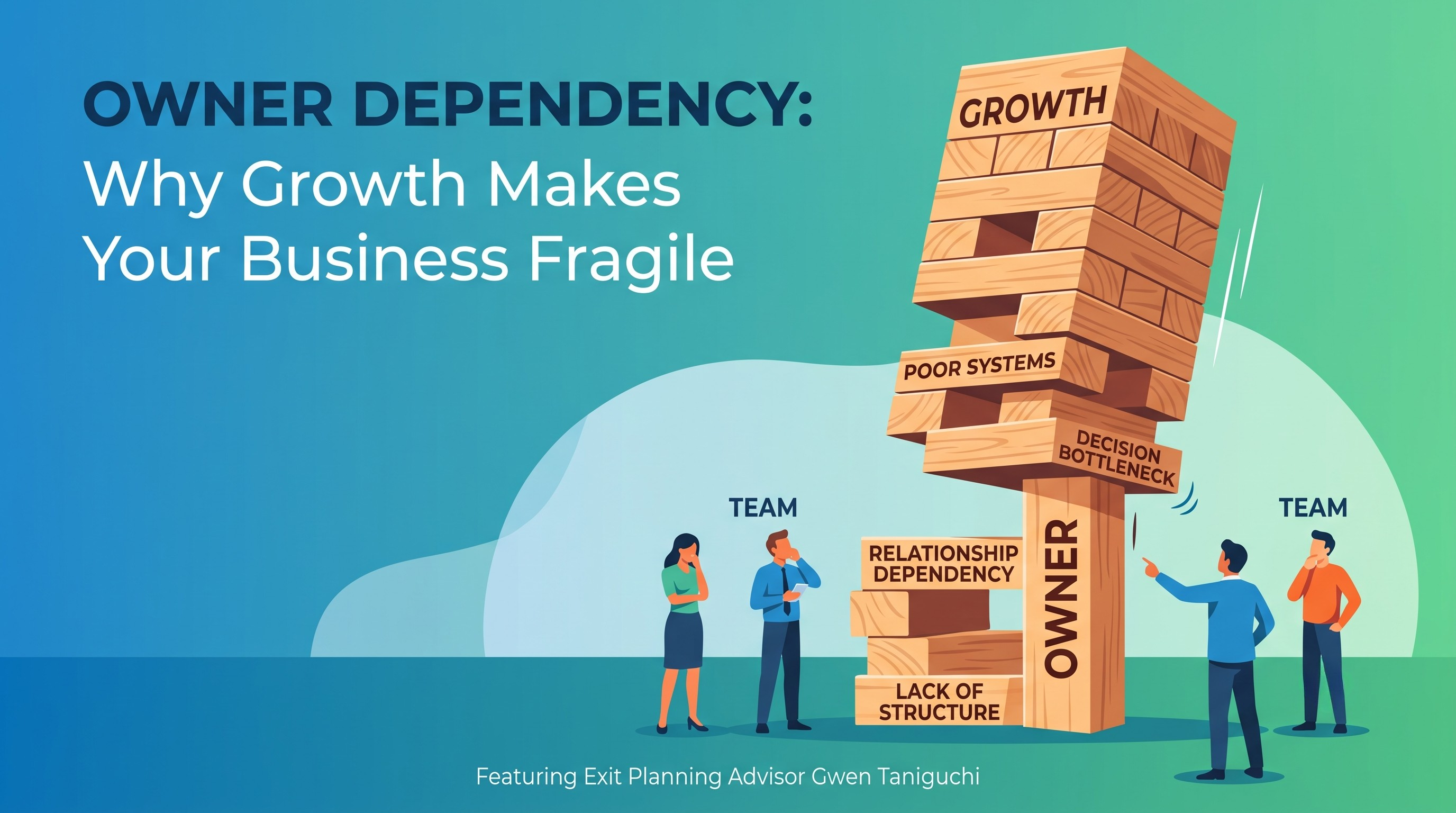
Owner Dependency: Why Growth Makes Your Business Fragile
Related Episode
Gwen Taniguchi: Fix the Founder Bottleneck Before You SellYou built the business on the thing you are best at. You became the expert, the one with the answers, the person every decision runs through. For a while, that is exactly what the business needed.
Then it grew. More revenue, more people, more clients. And somewhere in there the work got heavier instead of easier. You are busier than you have ever been, the numbers look good, and yet the whole thing feels like it would wobble if you stepped away for a week.
That feeling is not a sign that you need to work harder. It is a sign that the business depends on you in ways you have not fixed yet. Gwen Taniguchi, an Advisory Partner at Peek Advisory and a Certified Exit Planning Advisor who spent close to a decade as a fractional COO, has walked into hundreds of these businesses. Her diagnosis is blunt: growth does not make a business stronger. It exposes how fragile it already was.
Busy is not the same as healthy
The most common mistake at this stage is reading revenue as proof that the systems are fine. They usually are not. As Gwen puts it, revenue covers up poor systems. The problems were always there. Growth just made them impossible to manage by hand.
When you were smaller, you could answer the one-off question, catch the exception, and keep everything moving on memory and effort. The busier you get, the harder that is to sustain, and the more often the same question lands back on your desk. The business is not in crisis. It is a steady drip of minor frustrations, small delays, and little time sucks, and every one of them traces back to the same place. Busy does not mean healthy.
The decision bottleneck is the real constraint
Ask a founder which of the five things they hold onto longest, the numbers, the decisions, the client relationships, the team direction, or the problem solving, and Gwen says the answer is almost always the same. Decision making. And decisions that all run through one person create a queue.
The result is a backlog that never clears. Initiatives you set in the first quarter are still waiting in the decision line in the third, because the owner is also doing the delivery work, so there is never time to clear the line. Gwen worked with a real estate brokerage that looked like it was winning from the outside, top of its market on every metric. Underneath, everything ran through the owner. The team waited on her for every call. That is slow, and worse, it erodes the confidence and culture of people who could have moved on their own. Over time, that erosion costs real money, well past the operations headache it looks like at first.
Delegation is not the same as structure
Most founders believe they have solved this because they handed off tasks. Gwen draws a sharp line here, and it is the most useful distinction in the conversation. Delegation is the handoff of a task. Structure is the handoff of ownership.
Handing someone a task keeps you as the decision-maker. Handing them ownership means they own the outcome, and you have defined what a good result looks like so they can get there without you. That is not a manual on how you would do the job. It is a clear standard for what “done” means. Gwen does not start by pulling work off the owner’s plate. She starts by talking to the team and listening for irritation, because irritation is a signal most owners never track. Where the same question gets asked over and over, where someone has to check with one specific person before acting, that friction marks the exact place a real system is missing.
For a business doing two to three million dollars with a team of twelve, her first ninety days are deliberately unglamorous. Make it visible who owns what, by role rather than by personality. Assign that ownership clearly. Set a steady check-in schedule and run against a ninety-day set of objectives, then track progress so the before and after are obvious. The point is not perfection in the first sprint. It is fewer unnecessary dependencies, refined every month.
The value you cannot see until you try to leave
There is a version of this problem that survives even clean operations. You can document every process and still have every new client arrive because you personally knew someone. Relationship dependency is still dependency, and it does not transfer. When the relationship lives with you, it walks out the door with you.
This is where Gwen’s exit-planning view matters, because it puts a price on the problem. A good exit is planned three to five years in advance, and most owners wait far too long. When it is finally time to sell, buyers look past whether the business makes money. They ask how much of it depends on the owner, because that is risk, and risk is what lowers the price. Take the owner out of the middle and the business becomes more predictable, which is exactly what a buyer will pay for. And the same structure that makes the business sellable makes it better to run today, whether you ever sell or not.
Where this fits in the V3 Growth System
This is what the Valuable layer looks like when it is working. A business is Visible when the right clients can find it, Viable when it can convert and deliver without the founder in the middle, and Valuable when it is worth more than the owner’s time inside it. Owner dependency is a Value problem with its roots one layer down, in how the work actually gets done. Fix the structure, and the value follows.
What to do next
If this put words to something you have been feeling, the weekly newsletter is the place to keep going. Each week we break down one real growth constraint and how to spot it in your own business. Subscribe by putting your email in the box below, in the footer.
Want the full conversation with Gwen Taniguchi? Listen to the episode linked above. Or click here to connect with her.
And if you already suspect owner dependency is capping what your business is worth, a Growth Clarity Call will surface where it lives. Click here to book a free 45-minute call