Why AI Has Not Changed Your Growth Ceiling (And What Will)
Related Episode
Why AI Made You a Faster Bottleneck (And the Decision Layer Fix)Introduction
You adopted AI this year. Your proposals draft faster, your meetings summarize themselves, your content calendar fills itself. And six months later, nothing structural has changed. You are still the person who decides which leads move forward. Still the person who designs every onboarding sequence by hand. Still the person your team checks with before a deliverable ships to a client.
The pattern is consistent across service-based businesses in the $1M to $5M range. AI makes the edges of the business faster, but it does not touch the center. The founder remains the decision engine for every revenue-critical transition, and the business hits the same ceiling it hit before the tools showed up.
The problem is not the tools. The problem is the system the tools are being dropped into.
The misdiagnosis: tool selection versus system architecture
When AI does not move the needle, the default diagnosis sounds like this: “Maybe we picked the wrong tools, or the team is not using them well enough, or we need better training.” That diagnosis treats AI as the variable. The real variable is the revenue system underneath.
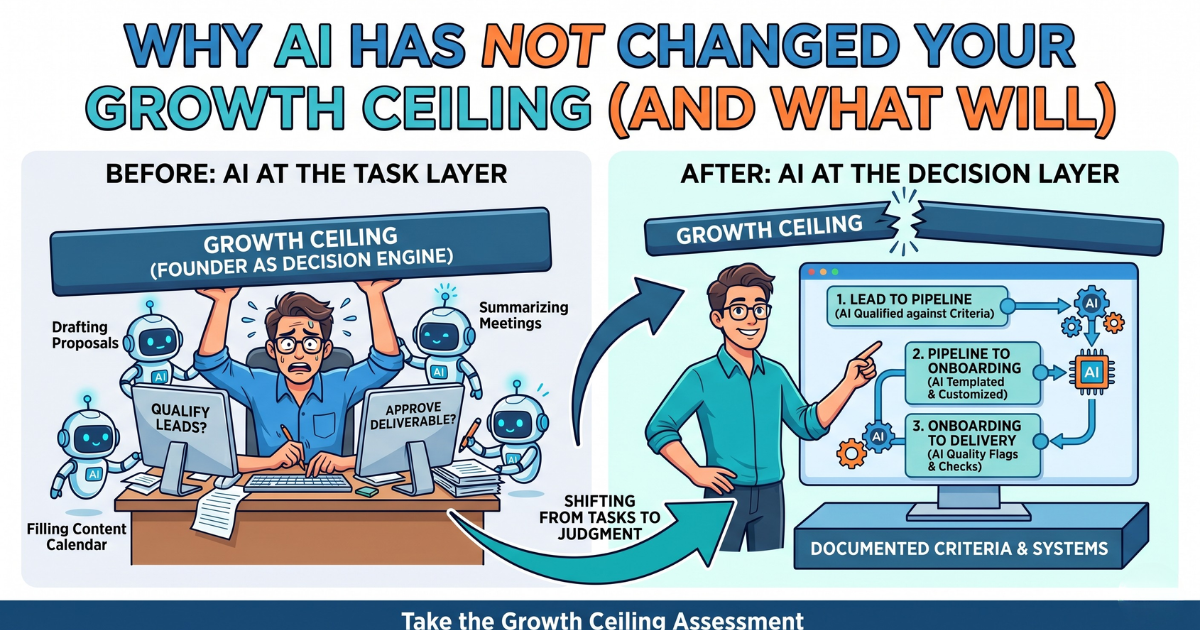
Every service business has three revenue-critical handoffs. Lead to pipeline, where an inbound inquiry becomes a real opportunity. Pipeline to onboarding, where a closed deal becomes an active client. Onboarding to delivery, where a new client moves from setup into ongoing work.
In most founder-led businesses, the founder’s judgment is embedded in all three. Not because they want to be there, but because no one ever designed a system that could make those calls without them. When AI gets layered on top of that structure, it writes better outreach emails (useful, does not change who qualifies the lead), summarizes discovery calls (useful, does not change who decides the deal is ready to close), and generates onboarding checklists (useful, does not change who checks the work).
The tools are doing the tasks. They are not replacing the judgment.
Task layer versus decision layer: the distinction that changes everything
There is a simple audit that reveals whether your AI implementation is in the right place. For every AI tool you currently use, ask one question: Is this tool operating in the decision layer of a revenue-critical handoff, or is it operating on the task layer around the edges?
AI writes my proposals: task layer.
AI qualifies my inbound leads against documented criteria and routes them without me: decision layer.
If every tool is on the task layer, you now know why AI has not changed your growth ceiling. The founder is still the system’s decision engine. AI just makes them a marginally faster bottleneck.
The shift starts not with tool selection but with documentation. Sit down and write the actual criteria you use to decide whether a lead is worth pursuing. Write the standard steps that repeat across every client onboarding. Define what “good enough” looks like at each delivery milestone in measurable terms, not vague descriptions.
This is not a technology project. It is a documentation project that technology then accelerates.
The three handoffs where founder dependency lives
The first handoff, lead to pipeline, is where most founders personally qualify every inquiry based on gut instinct. That instinct is real, but it is not a system. One founder we worked with was convinced her qualification process was pure intuition. When pressed, every decision mapped to specific, measurable criteria: budget thresholds, certifications, demographic markers. Once documented, the AI had something to score against.
The second handoff, pipeline to onboarding, is where deals close and momentum dies because the founder has to design each onboarding sequence from scratch. Most service businesses find that 70 to 80 percent of their onboarding is identical across clients. The remaining 20 to 30 percent is where real customization lives. AI implementation at this handoff means templating the standard path and surfacing only the customization decisions to the founder or a senior team member.
The third handoff, onboarding to delivery, is where the founder is certain no one can do it like them. The opportunity here is not generating deliverables with AI. It is building a quality standard into the system with measurable criteria at each milestone so the team can evaluate without the founder and the AI flags only exceptions.
What this looks like when Viability is working
This maps directly to the Viable pillar of the V3 framework: the mechanics of converting, transitioning, and managing your pipeline without the founder in the middle of everything. When the decision layer runs on documented criteria instead of founder judgment, pipeline velocity increases because deals stop waiting on one person’s calendar. And the founder gets the bandwidth to think strategically about the business instead of being consumed by routine handoff decisions all day.
Take the next step
If this pattern sounds familiar, start with the Growth Ceiling Assessment. It takes five minutes and shows you which part of your growth engine needs attention first.
Take the Growth Ceiling Assessment
For a deeper look at how founder dependency shows up in service businesses, listen to the full episode!