Competitive Advantage: Why Service Businesses Compete on Price
Related Episode
Craig Paxson: Your Growth Plateau Is a Positioning Problem“A competitive advantage is a reason a customer chooses you over every available alternative. Deliberately built, and consistently delivered.”
- Craig Paxson, Visionary Results
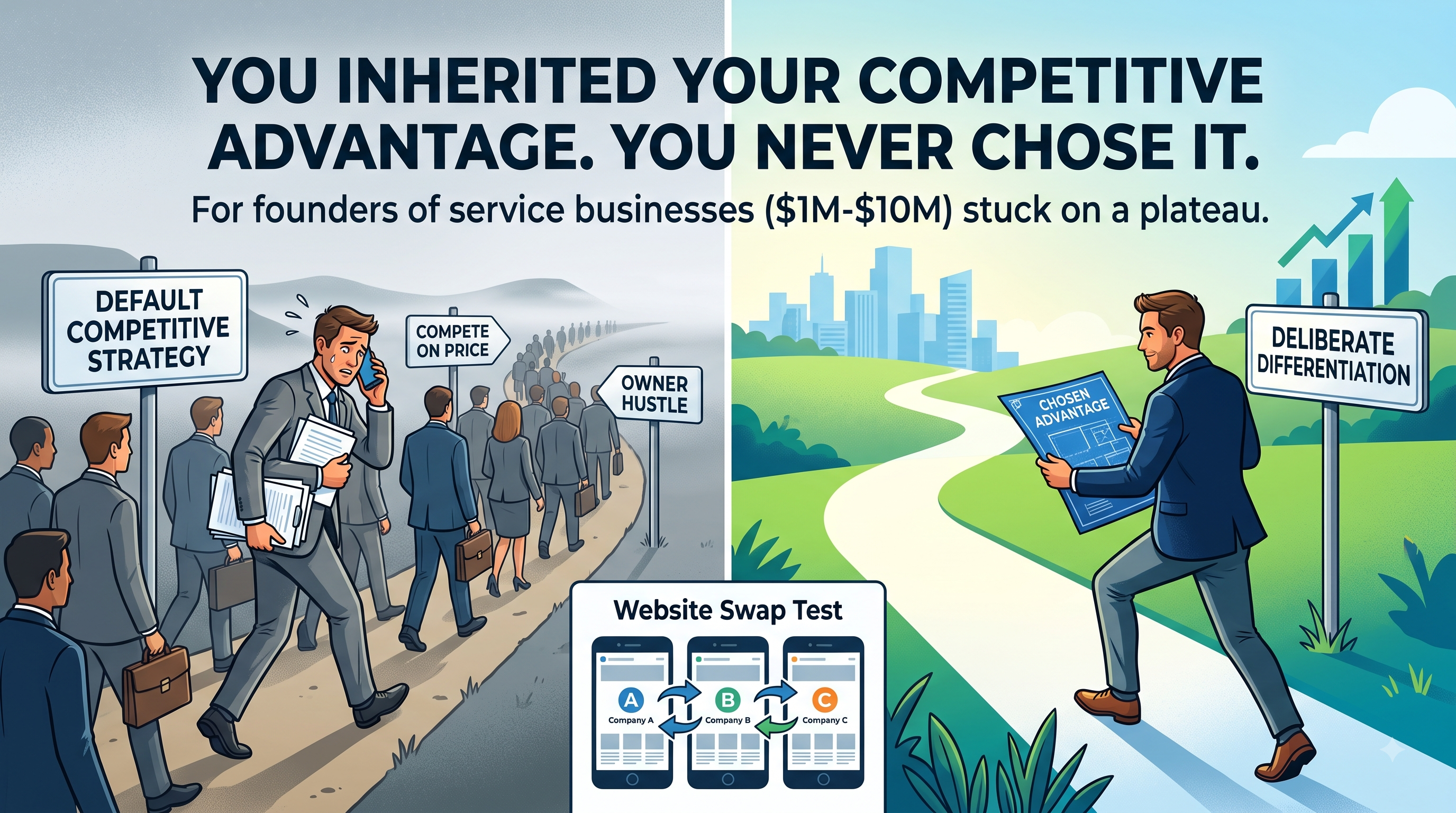
Pull up your website. Now open the websites of your three to five closest competitors in another set of tabs.
Cover the logos. Cover the company names. Change the colors in your head.
Can you tell who is who?
For most service businesses between $1M and $10M, the honest answer is no. The same claims appear on every site. Higher quality. Better service. Experienced team. Client focused. Every one of those is true, and not one of them tells a buyer anything, because every competitor says the same thing.
When a buyer cannot tell the difference, they fall back on the only two signals left. Price, or whoever reached them first. That is why growth stalls at this stage, and it is why hiring another person or spending more on marketing does not fix it. The constraint is not effort. The constraint is that nobody deliberately decided why a customer should choose this business over every available alternative.
Craig Paxson, who runs an outside-in strategy practice for owners in this revenue band, puts a precise definition on it: a competitive advantage is a reason a customer chooses you over every available alternative, deliberately built and consistently delivered. Most businesses fail on the middle word.
The question almost no owner can answer
Craig asks owners whether they inherited their competitive advantage or deliberately chose it.
Almost nobody can point to a process. They took over the business, or they started it doing work they already knew how to do, and the way the company competes is whatever was true at the beginning. It was never selected against alternatives, so it was never tested.
This matters because it is where bad advice compounds. Advisors ask the owner what makes the business different, collect three answers, and treat them as established fact. Higher quality than what? Quantified how? “We’re strategic” means nothing that a competitor could not also claim. Those answers get baked into the website, the sales conversation, and the pitch at the networking meeting, and none of them were ever checked against what competitors actually say.
Action step: write down your current answer to “why do customers choose us,” then find that same claim on a competitor’s website. If it is there, you have a description, not an advantage.
Read the market before you set a single goal
Craig described a company running a well-known operating system that had committed to doubling EBITDA to 20 percent. Best in class for their industry was 14 percent.
They had committed to being 50 percent better than the best company in their industry, with no plan to change anything structural about how they operated or priced. Nobody had looked outside the building.
The failure is not ambition. It is that an inside-out goal produces the wrong problem to solve. Growing revenue 20 percent in a market growing at 20 percent means holding your share. Growing revenue 20 percent in a flat market means taking share from a named competitor, which requires a completely different operating model. Same number in the plan, two entirely different businesses.
Craig’s placement approach reads two dimensions before any internal goal gets set. Is the market growing, stable, or shrinking. Is it commoditized, emerging, or differentiated. Those two axes produce nine strategic moments, and each one implies a different set of workable business models. An HVAC company in a small Tennessee town may sit in a different strategic moment than an HVAC company in Minneapolis, which means the same industry can require different strategies in different markets.
Action step: look up best-in-class margin for your industry and write your number next to it. Then write one sentence on whether your market is growing, flat, or shrinking, and what evidence supports it.
Choose the profit model before you choose the position
This is the step most positioning work skips.
Before deciding how you compete, Craig asks how the business makes money. Transactional, where you sell and the relationship ends. Subscription, where you earn over time. The razor handle sold at cost so the blades can carry the margin. Each model implies different costs, different funding, and a different shape of business.
Most owners inherited the profit model along with everything else. Then they try to attach a competitive position to a money model that cannot support it. The position fails, and it looks like a marketing problem.
To find where the advantage should live, Craig maps his client and their three to five real competitors across the seven stages of the buyer experience cycle, from price through purchase, delivery, use, supplements, and disposal. Price itself splits into four components, including timing and duration, because paying before delivery and paying after delivery are different products from the buyer’s side. He scores each stage zero to three, where zero means nobody cares about this and three means customers choose a vendor specifically for it.
The map shows where every competitor is weak in the same place. That gap is where a real advantage can be built.
Action step: list the seven stages of your buyer’s experience and score yourself and two competitors on each. The stage where everyone scores low is your opening.
Build the capabilities that deliver it consistently
An advantage nobody can deliver reliably is a claim.
Craig’s capabilities matrix starts with the four functions every business runs: create a paying customer, deliver the product or service, collect the money owed, and lead the organization. Against those four, he defines key activities, tools and resources, skills and people, policies, and measurements.
Then everything hangs off the advantage itself. His example is answering the phone by the third ring. If that is genuinely why customers choose you, then the phone system is a tools decision, staffing is a people decision, “answer by the third ring, every time” is a policy, and the percentage of calls answered in time is a measurement. A conversation with an employee about missed calls stops being arbitrary. It traces directly to why the company gets paid.
This is also where the founder finally gets to step out of the middle. Not because the work was documented, but because the standard is tied to something everyone in the building understands.
Action step: pick one standard your team is supposed to hold and trace it back to why customers choose you. If the line does not connect, either the standard or the stated advantage is wrong.
Owner dependency may be a model problem, not a documentation problem
The standard advice on owner dependency is to write everything down. Get it out of the founder’s head, document the processes, transfer the knowledge, raise the value of the business.
Craig’s research points somewhere else. Some profit models are structurally owner dependent and some are not. A transactional model puts the owner or the rainmaker in every sale by design, so documenting around it only moves the dependency to a different person who can also leave. A subscription model does not require anyone in the middle of each transaction.
So the question is not only how to document the owner out of the business. It is whether to move to a model that never needed them there. He described shifting a client from transactional to a mix of transactional and subscription in an industry where no competitor offered one, which he calls the courage question: are you willing to be the only one in your industry doing it?
What this looks like when Visibility is working
Visibility is not traffic. It is whether the right prospects can find you, understand you, and remember why you are the choice. When the Visible layer is working, a buyer comparing you to three alternatives can articulate the difference without your help, your team can state the reason customers pick you without checking a document, and pricing conversations stop defaulting to who will go lowest. Everything downstream, the pipeline and the retention and the referrals, gets easier because the answer to “why you” was settled before the conversation started.
Where to go from here
Every week I break down one real growth constraint and how to spot it in your own business.
Subscribe to the weekly read in the footer below.
Listen to the full conversation with Craig Paxson linked above.
Related reading: Owner Dependency: Why Growth Makes Your Business Fragile
If you already suspect the plateau is structural, a Growth Clarity Call is 45 minutes and you leave with your three constraints ranked by revenue impact.