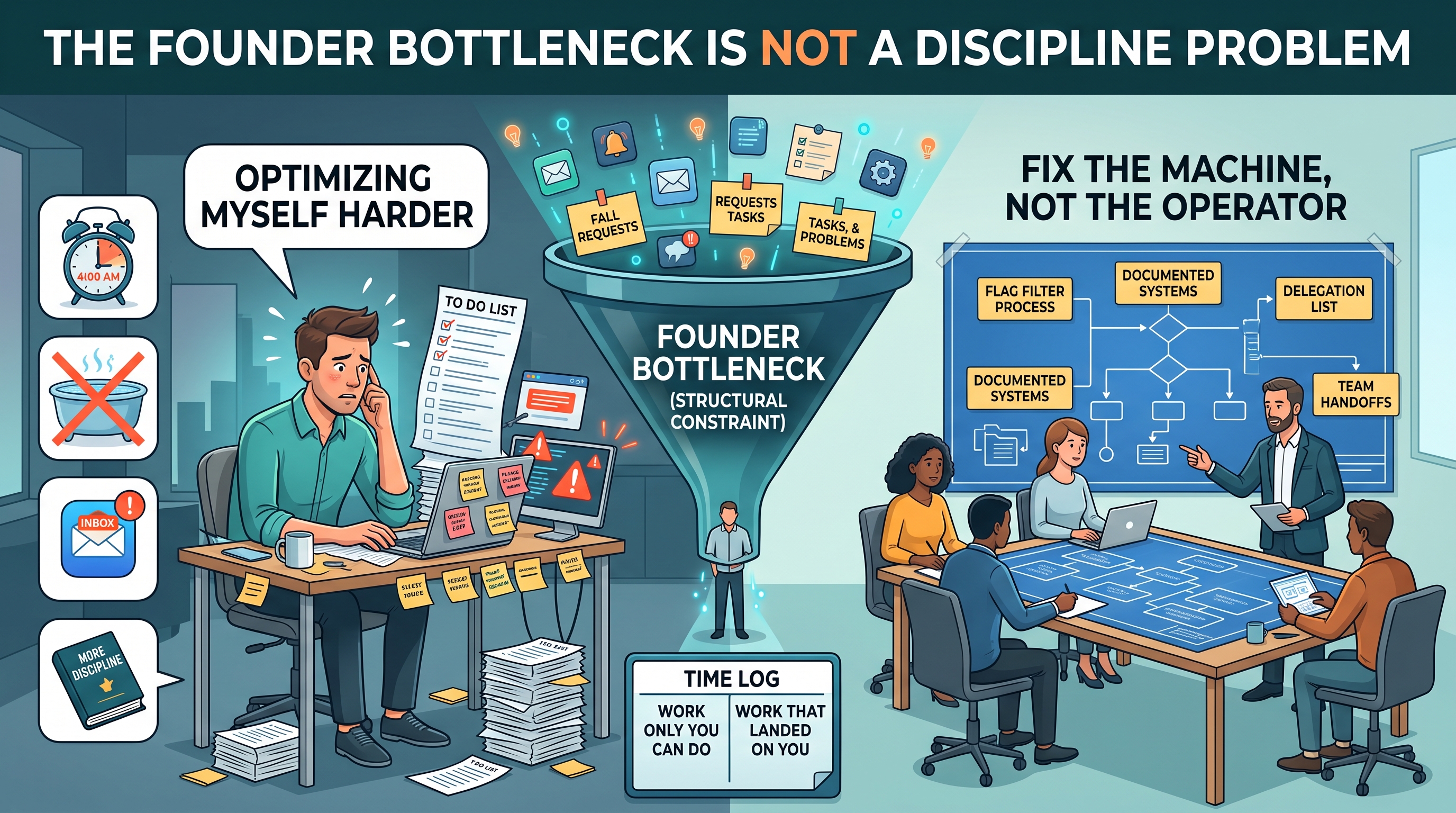
The Founder Bottleneck Is Not a Discipline Problem
Related Episode
Rob Tracz: Why the Founder Bottleneck Survives Your 4am RoutineEvery day is a Wednesday and there’s no weekends anywhere nearby. - Rob Tracz
By the time a service business crosses a million in revenue, its founder has usually proven one thing beyond doubt: they can handle anything. Every problem that came up got solved, and it got solved by them, because they were fastest and because explaining it took longer than doing it.
That is a real skill, and it is what got the business here. It is also, at a certain size, the exact thing that stops the business from getting further.
The pattern looks like this. The company cannot move faster than the founder can personally respond. The founder is already responding all day. So growth stops, and the founder reads the stop as a personal failure of energy or organization. The fix they reach for is more discipline: an earlier alarm, a tighter morning, a new productivity system.
That fix makes the problem worse, because it treats a structural constraint as a personal one. The founder bottleneck is not a shortage of discipline. It is a business designed so that every decision has to pass through one person, and no amount of personal optimization changes the design.
Optimizing the operator does not fix the machine
Rob Tracz spent more than a decade in human performance before bringing that lens to business owners. He holds a master’s in exercise science and a strength and conditioning certification, and his 2026 TEDx talk asks a question most founders never stop to consider: are we optimizing ourselves into burnout?
He arrived at the question the hard way. Early in his career he decided that if most people worked eight hours, he would work fifteen, and that weekends were two production days other people were wasting. Two weeks without a day off became two months. Two months became two years. He kept going through his father’s illness, telling himself there would be more time, and then worked another full year after his father died, because the schedule had become somewhere to put the grief.
When he finally rebuilt, he did what most founders do first. He optimized the morning. Four in the morning, workout, walk, cold plunge, meditation, reading. The routine finished at three in the afternoon and he needed a nap before starting work.
His description of that period is the most useful sentence in the whole conversation: adding more is like pouring gasoline, and the gasoline makes you go faster, but if you never slow down to check direction, you look up and you are a long way down the wrong road.
The action step here is deliberately small. Before you add anything to your routine, spend one week logging your time in two columns. Work only you can do, and work that landed on you because there was nowhere else for it to go. The second column is the actual constraint, and it is almost always larger than the founder expects.
The decision filter that goes upstream of everything
Most founders build systems downstream of decisions they never examined. They optimize execution on a direction nobody checked.
Tracz puts a filter upstream instead. He calls it FLAG, and it runs before a decision rather than after.
Foundational values come first, meaning the founder’s own, not the framed set on the office wall. Business values tend to sit close to personal ones, but until someone writes theirs down, they usually inherit somebody else’s by default.
Lifestyle alignment is second, and it carries the sharpest observation in the framework. People get good at doing something, start a business around that thing, and build themselves a second job rather than a company that can run. The test is whether what you are building actually matches the life it was supposed to produce.
Aspirations come third: the real goals for the season you are in, and what each one is meant to buy.
Growth opportunities close it. Who you are now produced the current ceiling, so the question is what skills the next version of the business will require from you.
Run one live decision through those four before you make it. The value shows up in what you stop doing, not in what you add.
Sort the work before you try to delegate it
Delegation fails in most growth-stage service firms for a reason that has nothing to do with the people hired. The work was never sorted before it was handed over.
Tracz uses three tests rather than the usual two. Urgent is time pressure. Important is consequence. Significant is whether it compounds into anything. A great deal of work passes the first two tests and fails the third, and that work is exactly what should leave the founder’s desk first, either to a person or to a tool.
He is measured about automation. The tools are genuinely useful for the fast, repeatable, low-consequence layer, and reaching for them as a way to replace people out of the gate is the wrong first move.
The step: take your current task list and mark every item that is not significant. That is your delegation list. What remains is the actual job.
A hire is not a process
The story that should worry any founder about to make their next hire involves a bookkeeping company.
The owner was putting out the same fires every day. She hired a team of two, expecting the workload to drop. She had no documented processes and no defined handoffs, so she assumed the new people would arrive and absorb the work by observation.
Her workload tripled. She was doing her own job plus supervising two people who had no way of knowing what finished work looked like.
What fixed it was not a third hire. She slowed down, set priorities, wrote the plan, and named specifically what was being delegated. The team started operating as a team. She got her weekends back, and used the recovered time to start attending networking events again, which brought in the business that funded the next hire.
The order matters and it is the opposite of what most founders do. Process first, then the hire, then the growth the hire was supposed to create.
What this looks like when viability is working
This is what it looks like when the Viability layer of the V3 Growth System is working. Viability asks a simple question: can the business convert, deliver, and decide without the founder standing in the middle of it? A company where every decision routes through one person has no viability to measure yet, because there is nothing running independently to measure. Fixing that is not a marketing problem and it is not a discipline problem. It is a structural one, and it is the layer that has to hold before anything above it compounds.
Where to start
The founder bottleneck is not a character flaw. It is a signal that the business was built around one person’s constant response, and that the design has reached its limit.
Start with the count. One week, two columns, and a tally of how many decisions stopped on your desk. The number is the diagnosis, and it is usually enough to end the discipline conversation on its own.
Get the weekly constraint read. Every week we break down one real growth constraint and how to spot it in your own business. Subscribe in the footer below.
Listen to the full conversation with Rob Tracz linked above.
Want your business diagnosed directly? A free 45-minute Growth Clarity Call ends with your three constraints ranked by revenue impact.