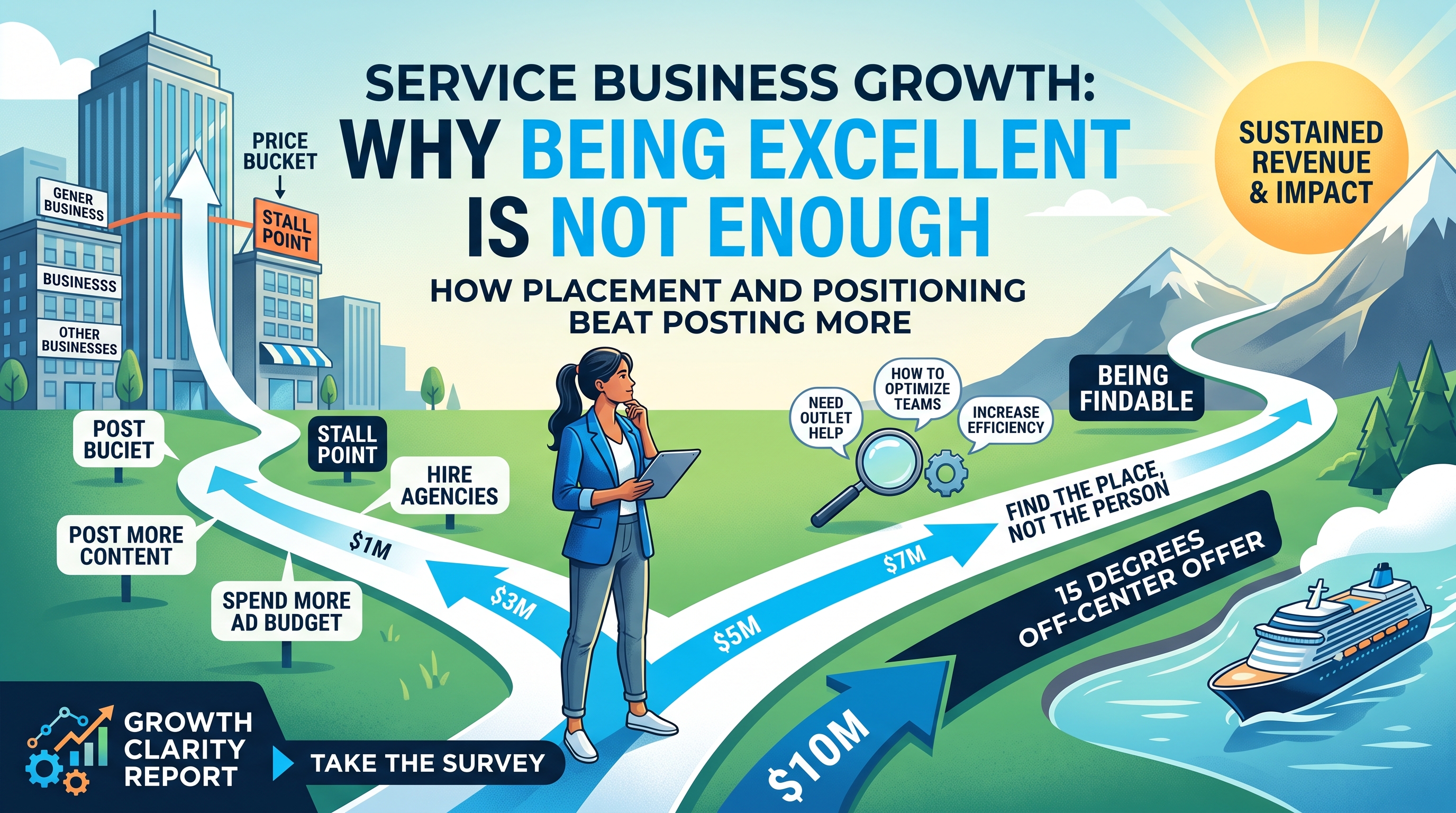
Service Business Growth: Why Being Excellent Is Not Enough
Business owners focus on making the best bread, not on letting people know how to get their bread. And the best bread isn’t the bakery that stays. It’s the one that sells the most. - Joe Rockey, The Growth Ceiling Podcast
There is a specific frustration that shows up around the $1M to $10M mark in a service business. The work is good. Clients say so. Retention is fine. And the pipeline still depends on who happens to know you.
Meanwhile a competitor with a thinner offer keeps turning up in the conversations you should be in. The natural conclusion is that they found a channel you have not, so the response is to post more, spend more, or hire someone to do both.
That response usually fails, and it fails for a structural reason. Being excellent and being findable are two different jobs. Service business growth stalls when a founder has only ever worked on the first one.
Your ideal client is a problem, not a profile
Most businesses define their audience by demographics: age, income, region, industry, company size. Joe Rockey, who runs the consultancy Elite Business Cruises and has worked on visibility across nonprofit fundraising, real estate, automotive, and sales, argues that this is the first wrong move.
His position is that demographic data tells you nothing useful about who buys. One question does. What problem does this person want solved, and do you solve it? Everything else is logistics.
The reason this matters is not philosophical. When you define the audience by profile, you choose channels by profile, and channels do not work that way. There is no demographic that owns YouTube. There is no age bracket that owns Reddit. Those places have no entry criteria, so a profile cannot tell you which one is yours.
There is a second cost. When you describe your business from the inside, you describe it in expert language. You write the question you would ask if you already knew what you know. Your buyer does not know that, and increasingly the first place they type their version of the question is an AI assistant, which takes their words literally rather than translating them into yours.
Action step: Write the problem you solve in one sentence, using the exact words a client used the last time they described it to you. Compare it to your homepage headline.
Find the place, not the person
Once the problem is written correctly, the question changes from who to where. Where does someone with this problem already go, before they know your name?
Joe puts it in one line: you are finding the place, not the person.
The example he uses is a homeowner searching for how to wire an outlet. That search does not look like a lead. Two hours in, when the job is harder than the video suggested, it becomes one. The person who showed thirteen ways to do the work competently is the person who gets the call. Being present at the point of the question is what made that possible.
This is the practical difference between paying for attention and being placed where attention already lives. One requires a budget that never stops. The other requires knowing where the search starts.
Action step: List the three places a person with your client’s problem looks for an answer before they know you exist. Then check whether you are answering the question in any of them.
Fifteen degrees off center
Business positioning is where most of this work actually gets decided, and Joe has a specific measure for it.
Move too far from the category and nobody can tell what you do. Stay too close and you land in a bucket with everyone else, where the only remaining variable is price. Fifteen degrees is the distance where the buyer still recognizes what you sell but has nothing to compare it against.
His own firm demonstrates it. Most consultancies open by naming what is broken. His opens with the premise that the client is already competent, the work will make them better, and the engagement ends with the team celebrating together on a cruise. The underlying outcome is the same one every consultancy sells: the team performs better and the business earns more. The object being purchased is not comparable, so there is no anchor price.
There is a clean diagnostic for whether you have done it. If prospects arrive carrying complaints about what your competitors did to them, you are still in the bucket. When you are genuinely off center, those preconceptions do not come with the meeting.
Note what the move is not. It is not a better font, a new palette, or a sharper tagline. It is a change to the offer. That is slower and it carries more risk, which is exactly why so few businesses in a crowded category ever escape it.
Action step: Ask your last five prospects what they thought you were before the first call. Write down the bucket. Then name one element of the offer you could change so the bucket stops applying.
The pressure does not go away, it changes
One thing worth preparing for. When visibility starts working, the problem does not end. It converts.
The founder who spent two years asking how to get seen now has to answer a different question: can we prove it, and can we deliver at this level. Joe’s observation is that some founders never solve the visibility problem because, without being able to name it, they prefer the first problem to the second one.
That is worth sitting with, because it explains a pattern that looks like distraction and is actually avoidance. It is easier to keep adjusting the website than to build the delivery capacity that a working pipeline will demand.
Action step: Before you change anything about visibility, write down what breaks if inbound interest triples next quarter. Fix the first thing on that list in parallel.
Where this sits in the V3 Growth System
This is what it looks like when the Visible layer is working. Not more activity, but the right people finding you, understanding what you do, and remembering you well enough to come back. Visibility is the first layer for a reason. When it is broken, every improvement downstream in conversion and delivery gets applied to prospects who were never the right ones.
What to do next
We are running original research on where this actually breaks. The Growth Ceiling Report is mapping what runs on a founder’s systems, what runs on the founder personally, and where predictability breaks in service businesses between one and ten million. It takes about four minutes, the data is aggregate only, and you see your own results immediately, including how many of the eight revenue stages currently run without you.
Click here to take the survey.
The full conversation with Joe Rockey is linked above.
If you want the constraint named rather than guessed at, book a free Growth Clarity Call. Forty-five minutes, and you leave with your three constraints ranked by revenue impact (and a whole lot more).