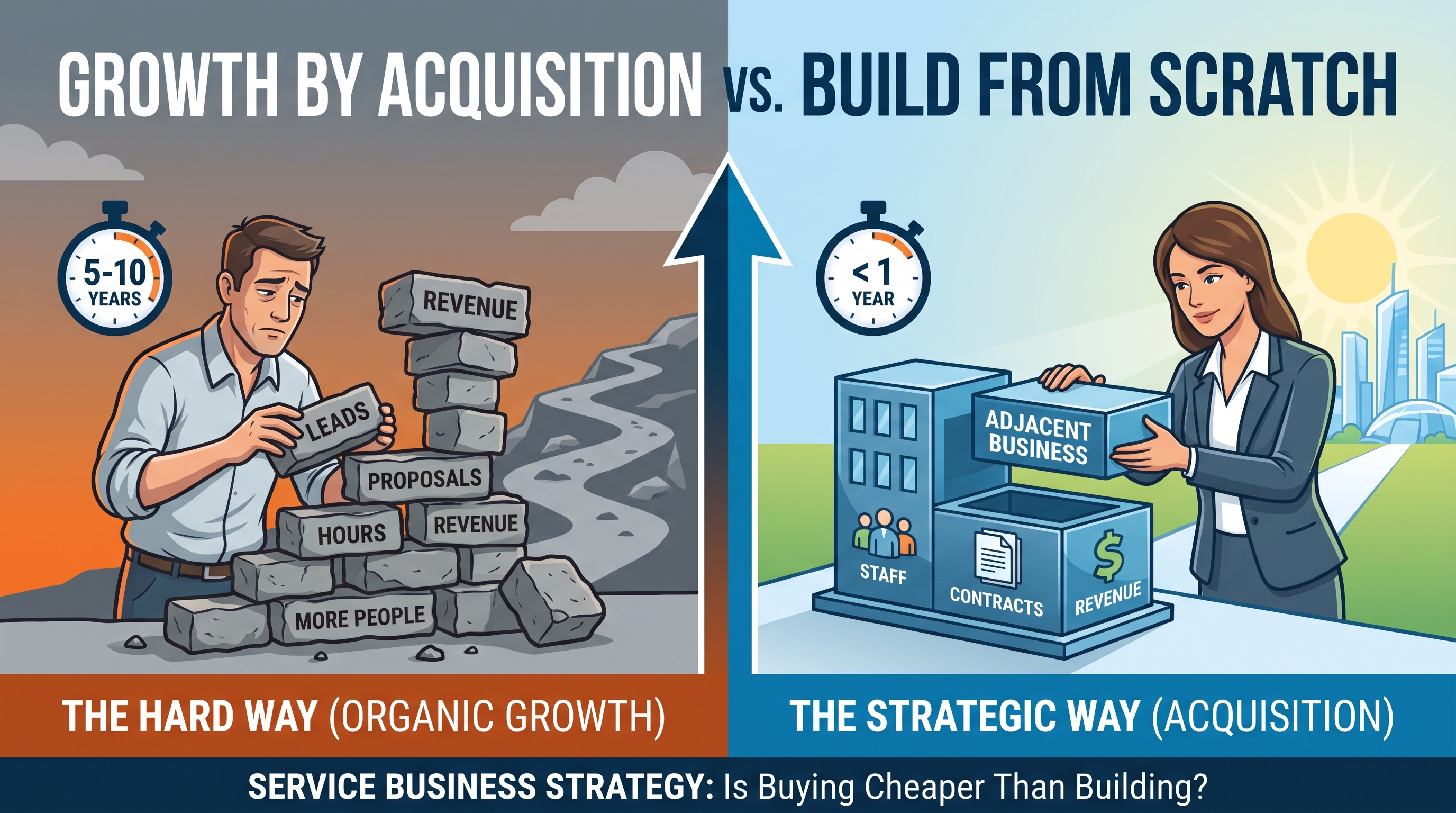
Service Business Growth: Why the Next Million Is Cheaper to Buy
Ask how long your first million took. That is the price of organic growth. Almost nobody puts a number on it, which is why almost nobody compares it to anything. Nate Grossman, The Growth Ceiling Podcast
Ask a founder running a two million dollar service business how they plan to reach three, and the answer is almost always some version of more. More leads. More people. More markets. More hours.
Ask how long the first million took, and the answer is usually five to ten years of hard fighting.
Those two answers sit next to each other without anyone noticing the problem. The plan for the next million is the same plan that took a decade to produce the first one, and it has never been compared against anything, because most owners of service businesses have exactly one mental model for growth: you generate it, one client and one proposal at a time.
There is another model. It is not new, it is not reserved for private equity, and it operates at sizes far below where most founders assume it starts. You can buy revenue instead of earning it.
Erika Baez-Grimes is a certified mergers and acquisitions advisor with more than fifteen years leading transactions across the main street and lower middle market, and she holds ownership positions in companies she has acquired. Her position is that owners between one and ten million routinely overlook acquisition, and that the reason is not analysis. It is that the option was never on the list.
The argument here is narrower than “buy a company.” It is this: the work that makes a business capable of absorbing an acquisition is the same work that determines what that business sells for later. Whether you ever buy anything or not, that is the work.
The real cost of organic service business growth
Nobody prices organic growth, because it does not arrive as an invoice. It arrives as years.
Baez-Grimes frames the comparison directly. If the first million took five to ten years, that is the benchmark any alternative gets measured against. A comparable million is available on listing sites right now, already staffed and already producing.
She walks the math on a bolt-on acquisition. Consider a million dollar company where the seller takes home two to three hundred thousand a year. Servicing the acquisition debt runs in the neighborhood of a hundred thousand annually, which leaves the new owner up somewhere between a hundred and fifty and two hundred thousand in the first year. The buyer brings roughly a hundred thousand of their own capital as a down payment. Inside twelve months, a million dollar company has become a two million dollar company, and the down payment has largely been earned back.
The point is not that the numbers always work. They frequently do not. The point is that most owners have never run the comparison at all, which means the slower path was never chosen. It was assumed.
Growth you never priced is not a strategy. It is a default.
What founders actually buy, and how the deal gets funded
The most workable first acquisition tends to be adjacent rather than identical.
The pattern shows up clearly in home services. A heating and cooling company buys a plumbing company, then an electrical company. The customer is the same homeowner. The company has not entered a new market so much as gained two more reasons for an existing customer to call.
What changes hands is rarely just revenue. It is crews holding licenses with fifteen or twenty years in the field, rather than hires who need training. It is an established process, sometimes better than the buyer’s own, that can be adopted across both companies. It is reputation and contract history that a younger company cannot manufacture at any speed. A six-year-old firm buying a fifty-year-old firm with government contracts is buying decades of standing.
Then there is the objection that stops most founders before they start: the money.
The number in an owner’s head is the sticker price, and it should not be. Baez-Grimes uses the house comparison. You did not pay cash for your home. For deals under five million, her rule of thumb is roughly ten percent down. A million dollar business means about a hundred thousand.
She described one buyer who arrived with forty thousand dollars in a retirement account and two firm conditions: the seller had to be drawing a salary of seventy-five thousand or more, and the seller had to be working on the business rather than in it. He found a home organization company where the owner ran scheduling rather than doing the work. It was listed near two hundred and fifty thousand and he bought it for one hundred and ninety-nine. Forty thousand down, seller financed the balance, no bank involved.
What he brought that mattered as much as the cash was a credit report and proof of funds, offered without being asked. Sellers extend financing to buyers who arrive prepared.
What kills a main street deal
Three risks account for most of the damage, and none of them are visible in a listing.
Client concentration is the one Baez-Grimes says shows up most often with first-time buyers working without representation. When a single client is twenty percent or more of revenue, the question is whose relationship it actually is. If it belongs to the owner who is about to leave, it may leave with him.
Revenue mix is the second. A company entirely dependent on government contracting carries exposure to a change of administration that has nothing to do with how well the business is run. Owners with a mix of public and private work have diversified that away on purpose.
Key person risk is the third, and it is the one that hits professional services hardest. Patients go to that dentist. Clients hire that attorney. When the person is the product and nothing contractually holds those relationships in place, the buyer is acquiring a list that can walk out.
The fourth category is not a risk so much as a landmine, and it is the books. Baez-Grimes described a daycare transaction where a lien search three weeks before closing turned up more than six hundred thousand dollars in IRS liens against a business selling for slightly under that figure. The business could not transfer. The deal ended, and the seller was exposed for having represented that nothing stood in the way of a sale.
A deal that collapses at the closing table has almost always failed diligence, not negotiation.
Owner dependency is priced, and not in your favor
This is where the argument turns back toward the reader’s own company.
Baez-Grimes is currently working with a physician who runs his mortgage, his vehicles, and his vacations through the business. Each of those may be individually defensible. Collectively they mean no buyer can see what the company actually earns. Books in that condition, she says, discount a business by thirty percent or more.
The deeper version of the same problem is the owner. She lays out two companies with identical revenue. In the first, an owner-operator earns two hundred and fifty thousand doing the work. In the second, an absentee owner earns a hundred and fifty thousand while paying a manager a hundred thousand to run it. A buyer prefers the second one, and pays more for it, because the second one can be repeated fifteen times and the first one cannot.
The size of that gap surprises most owners. In moving and storage, she describes moving revenue trading at roughly two and a half to three and a half times owner earnings, while the storage revenue trades between six and fourteen times. Same company. The difference is that storage recurs and does not depend on anyone being the star of the show.
There is a version of this that has nothing to do with selling. An owner who never sells still gets a business people want to work in, the option of transferring it to employees or children on decent terms, and the ability to raise capital, because investors fund machines that run the same way in Wisconsin as they do in Washington.
Where this sits in the V3 Growth System
This is what it looks like when the Value layer is working. Value asks whether the business is worth more than the founder’s time inside it, and an acquisition is simply the moment that question gets answered by a third party with money. The mechanics that produce a strong answer, clean financials, documented process, revenue that does not route through one person, all live in the Viability layer underneath it. Buying a company tests both at once, which is why the readiness work comes first.
What to do next
We are running original research on exactly this question. The Growth Ceiling Report is mapping what runs on a founder’s systems, what runs on the founder personally, and where predictability breaks in service businesses between one and ten million. It takes about four minutes, the data is aggregate only, and you see your own results immediately, including how many of the eight revenue stages currently run without you.
Erika Baez-Grimes appeared on The Growth Ceiling podcast to discuss buying, building, and exiting. Listen to the full episode linked above.
If you suspect the constraint is not your growth plan but the structure underneath it, a Growth Clarity Call is forty-five minutes and you leave with your three constraints ranked by revenue impact.