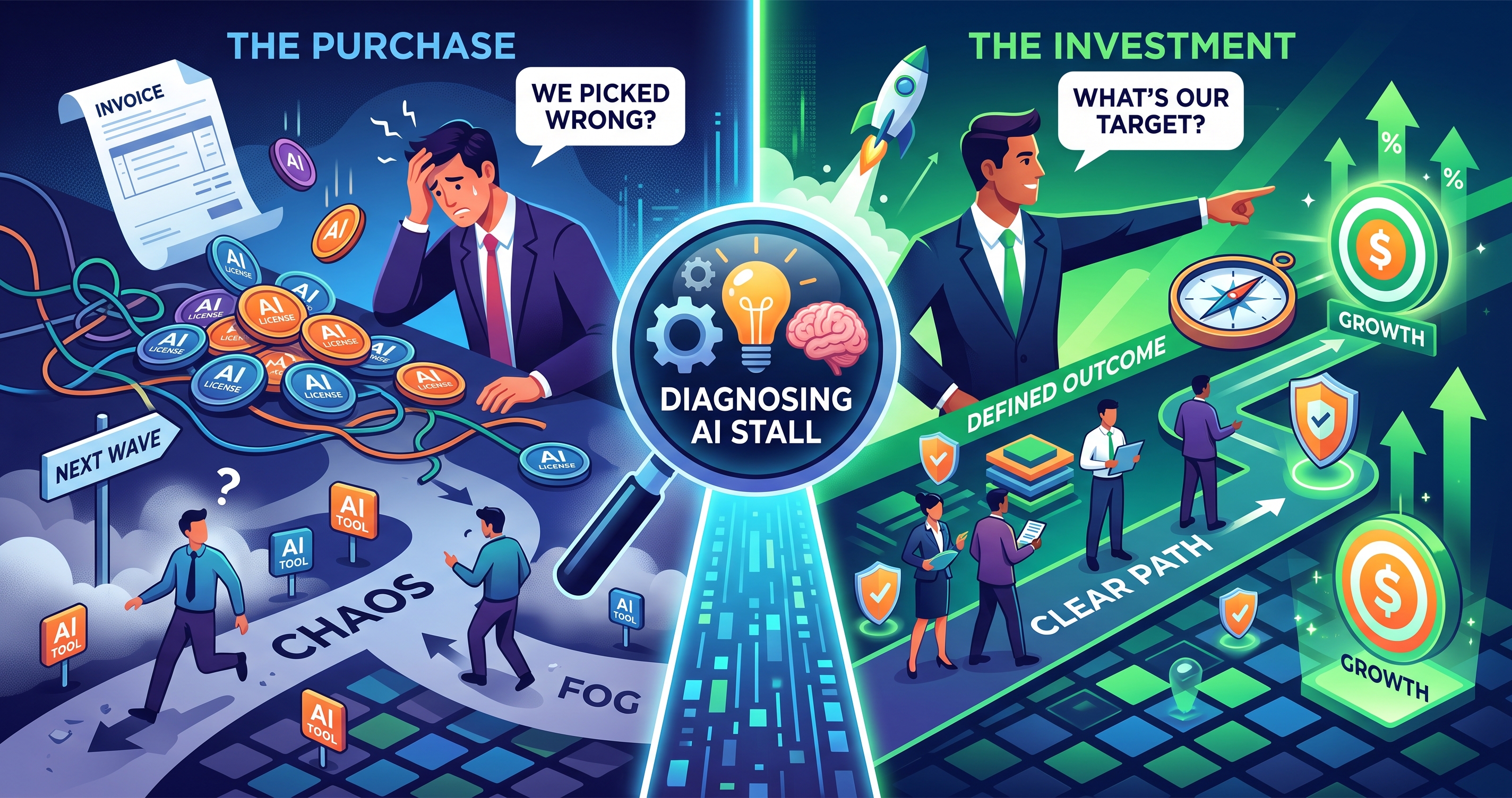
Why AI Implementation Stalls in Growing Service Businesses
Related Episode
AI Did Not Cause Your Growth Ceiling. Leadership Did.You didn’t make an investment. You bought stuff and you gave it to your organization. - Brian Beck, Proxurve
A founder spends real money on AI. Licenses for the whole team, a vendor, maybe a consultant. Six months on, the invoice is predictable and the business is not measurably different. Nobody can point to a process that works another way now.
The conclusion most founders reach is that they picked wrong. Wrong model, wrong vendor, wrong timing. So they wait for the next wave and try again.
That diagnosis is comfortable and it is wrong. The stall almost never starts at the tool. It starts at a decision nobody made before the tool arrived, and everything after that decision inherits the gap.
Brian Beck has spent 35 years in technology and now works with leadership teams of small and mid-sized organizations on where AI and cybersecurity belong in a business. He is direct about where the failure begins. “If we can’t define what we’re trying to go towards, how are we supposed to be able to go towards anything meaningful?” That is a leadership question, not a technology question, and it is the one that determines whether the spend becomes an investment or stays a purchase.
Spending money is not the same as making an investment
There is a version of this that plays out often enough to be a pattern. A company decides to roll out a tool and gives it to everyone at once. No framework, no acceptable use policy, no definition of what good looks like, no training. In an organization of a hundred people or more, the monthly cost per seat adds up quickly.
Then leadership looks at the bill and asks why they are not seeing a return.
Beck’s answer is unsentimental. You did not make an investment. You bought something and handed it to your organization, and you gave your team no guidance about what to do with it.
The difference between the two is a defined outcome. An investment has one attached before the money moves. Name the process that should work differently, name the number that proves it did, and the tool decision becomes obvious and much smaller. Skip that, and you are left with what Beck describes as chaos, which turns expensive fast.
The tell is in the language. When people describe what the tool is for and the words are things, stuff, and something, no one has defined a target. There is no version of that sentence that ends in a measurable result.
Security is what lets you say yes
Ask a room of business owners how many get excited about cybersecurity and you will get a handful of hands. Beck has run that exact test in front of a couple hundred owners. Five raised their hands.
The word reads as restriction, which puts it in opposition to the thing everyone actually came to talk about.
Reverse the order and it stops being a brake. If role-based permissions, access control, and an acceptable use policy are in place, a leader can turn an entire team loose on company data and know the boundaries hold. Without them, the only safe options are to move slowly or to move recklessly.
This is the practical case, not a compliance argument. Security is not the tax you pay for the rollout. It is the thing that makes a full rollout possible at all, which is why Beck starts there with a business at two to three million in revenue rather than starting with the tool.
There is a structural decision underneath it that most small businesses have avoided. Many are straddling two ecosystems, with email in one place and files in another, some staff in Microsoft 365 and some in Google. Two ecosystems means two security models and two administration paths, which raises complexity, cost, and risk together. The instruction is simple and unpopular: commit to one, chosen on where the business is going rather than on what people are used to.
Your data decides the quality of the answers
Here is the step founders skip, and it is the one that sets the ceiling on everything else, without ever announcing itself.
Ask whether your company’s data is structured consistently. In Beck’s experience the honest answer is almost always no. One person organizes it one way, another a second way, a third has their own system, and none of it is written down.
Drop a capable model into that and it has no way to know where information lives, who owns it, or how the pieces relate. So it fills the gap with a guess. A meaningful share of what gets called hallucination traces back to exactly this, to an environment that was never prepared rather than to a defective model.
Beck’s comparison is the most useful frame in the whole conversation. Treat AI as the most capable intern you will ever hire. No competent leader gives an intern access to everything on day one, explains nothing about the role, and then holds the intern responsible for the output. You define the role, set the boundaries, say what a good result looks like, and check the work.
Do that for the system and the output changes. Skip it and you are paying for confident guesses.
A rollout is not a distribution
The clearest picture of failure in this whole conversation is a room.
Beck was asked to come in and coach a staff through a full rollout. He had asked for specific things to be in place first. He was told they would be. He walked in and none of them were.
So he read the room instead. Of roughly 75 to 100 people, about a quarter were genuinely excited. Close to a third raised their hands to say they believed the tool was there to take their jobs. The rest sat in between, waiting to see which group turned out to be right.
That is what an absent framework looks like from the inside. Enthusiasm and fear in the same room, pointed in opposite directions, with nothing to align them. The people who have a bad experience then have every reason to conclude the technology does not work, and the organization inherits that belief for years.
The correction is unglamorous. Name the outcome for each team. Set permissions that match the role. Say who is leading the effort for that group. Have leadership use the tool visibly rather than delegating the whole question downward. Beck is firm that this cannot be handed to middle management while the founder stays out of it, because the signal that leadership is not invested is the signal the team acts on.
There is a hiring consequence too. Every recent graduate Beck talks to is already using these tools, and universities now run formal orientations on appropriate use. A candidate sitting in your interview can tell within minutes whether your organization has a position on this or not. A disjointed rollout is visible from outside the building.
Where this sits in the growth picture
This is a Viability problem in technology clothing. Viability is the layer where internal systems and decisions either carry the next stage of growth or fail under it, usually without anyone noticing until the pressure is already on. A business can be visible, sell well, and still be assembled in a way that cannot absorb what it just bought.
That is why the AI question so rarely resolves inside the AI conversation. The answer depends on whether the ground underneath it holds.
What to do this week
Start with an inventory. List every tool the business pays for and write the outcome each one was purchased to produce. The ones with no answer are the ones to address first.
Then find out whether you are running two ecosystems, and ask your technology lead one question: what does good look like for AI use here, and is it written down anywhere. If the answer is no, that is the work, and it costs nothing to begin.
Find out where your own system stands. We are running original research with founders of service businesses between $1M and $10M on where the revenue system breaks first. Sixteen questions, about four minutes, and you see your result immediately: how many of the eight stages of your revenue system run without you. Take it at thegrowthceiling.com/report.